

The Fiery Welcome
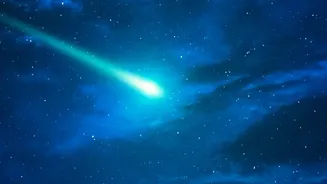
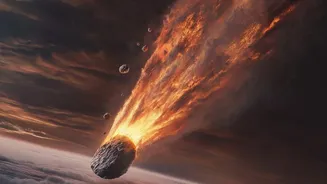
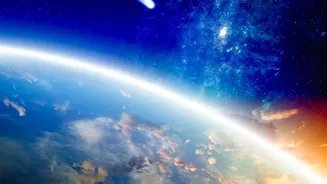
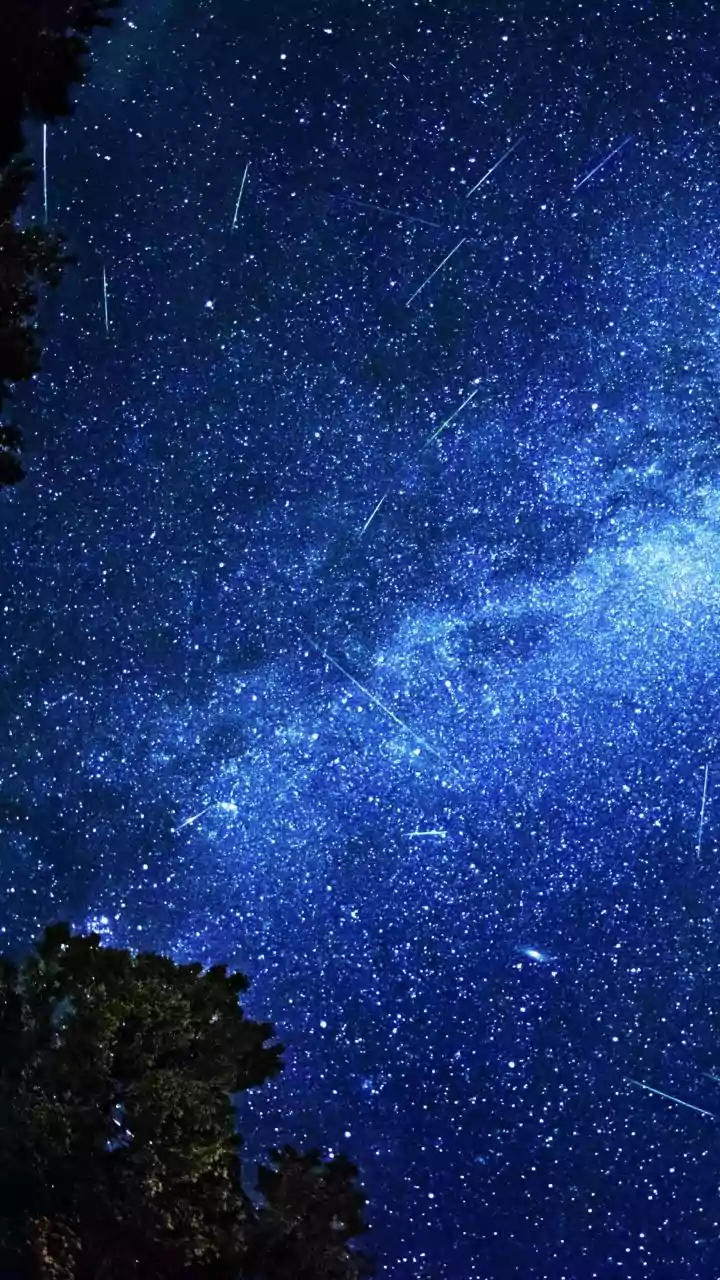
The investigation begins with a flash of light. When a meteoroid, a piece of rock from space, hits our atmosphere, it burns up and creates a bright streak called a meteor or fireball. To catch these fleeting events, scientists have set up sophisticated
networks of all-sky cameras, like the NASA All-sky Fireball Network and the Global Fireball Observatory. These cameras are spread across large areas and have overlapping fields of view. When a fireball streaks across the sky, multiple cameras record it. This simultaneous observation is crucial. Using the principles of triangulation—similar to how your brain uses two eyes for depth perception—researchers can precisely calculate the meteor's trajectory through the atmosphere, its speed, its brightness, and how it decelerates. This initial data is the first set of clues in solving the mystery of its origin.
The Search on the Ground
Not all meteors survive their fiery descent. But if the object is large enough and slow enough, pieces can reach the ground as meteorites. The camera data helps scientists determine if a meteorite fall is likely. They then use models to predict how upper-atmosphere winds would have affected the fragments during their 'dark flight'—the part of the journey after the fireball extinguishes. This allows them to calculate a 'strewn field,' an elliptical area on the ground where the meteorites most likely landed. Sometimes, even weather radar can be used to track the falling fragments. Then, the hunt begins. Researchers and enthusiasts search this area, looking for rocks that stand out. A key feature is the fusion crust, a thin, dark, glassy layer formed when the rock's surface melted during atmospheric entry. Finding these cosmic treasures is essential for the next stage of the investigation.
Reading the Secrets in the Stone
A recovered meteorite is a time capsule from the early Solar System. In the lab, scientists perform a detailed analysis. They study its mineralogy and chemical composition. A crucial technique is spectroscopy, which analyzes how the meteorite sample reflects light at different wavelengths. This creates a unique spectral 'fingerprint'. Different types of meteorites—like chondrites, which are unmelted primordial rocks, or achondrites, which come from bodies that melted and differentiated—have distinct fingerprints. Scientists also examine isotopic ratios, which are variations of elements that can act as a signature for where in the solar system the rock formed. This analysis not only classifies the meteorite but also provides a detailed description of the suspect's parent body.
Rewinding the Cosmic Clock
With the physical evidence from the meteorite in hand, scientists return to the initial fireball observations. The precise trajectory data captured by the camera networks allows them to perform a remarkable feat of celestial mechanics: they calculate the meteoroid's orbit around the Sun before it encountered Earth. By essentially running the clock backwards, they can determine the object's path through the Solar System. This involves complex calculations that account for Earth's gravity and motion. The result is a set of orbital elements—the specific parameters of the path it took—which describes the original home turf of the space rock. This pre-arrival orbit is the final, critical piece of the puzzle needed to identify the source.
Finding a Match in the Heavens
The final step is to connect the dots. Researchers now have two powerful sets of data: the chemical and spectral fingerprint of the meteorite, and the calculated orbit of the meteoroid it came from. They then search through astronomical databases of known asteroids. The goal is to find an asteroid or asteroid family that not only has a similar orbit but also has a spectral signature that matches the meteorite's fingerprint. When both the orbit and the composition line up, scientists can confidently link a meteorite found on Earth to its specific parent body millions of kilometers away in the asteroid belt. This incredible process, from a fireball to a fragment to a faraway asteroid, effectively provides a sample-return mission without ever having to leave Earth.