



Meet SHAPE, India's Exoplanet Hunter
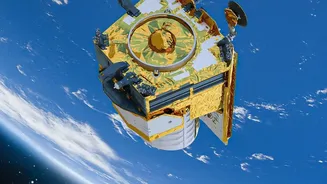
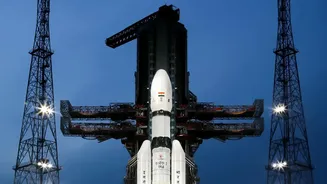
SHAPE, which stands for Spectro-polarimetry of a Habitable Planet Earth, is a sophisticated instrument developed by the Indian Space Research Organisation (ISRO). It was the sole scientific payload on the propulsion module of the historic Chandrayaan-3
mission, which successfully landed a rover on the Moon. After separating from the lander, the propulsion module continued to orbit the Moon, giving SHAPE a unique and distant vantage point to observe Earth. Conceptualised and built by scientists at the U. R. Rao Satellite Centre in Bengaluru, SHAPE's primary mission is experimental: to study the specific characteristics of light reflected from our own habitable planet. The goal is to create a detailed benchmark that can be used to identify similar potentially life-sustaining planets, or exoplanets, orbiting distant stars.
The Science of a Planet's Glow
When we look at a distant planet, we are essentially seeing the light from its star bouncing off it. This reflected light is not just a simple glow; it carries a wealth of information. SHAPE is designed to analyse this light in two specific ways: spectroscopy and polarimetry. Spectroscopy breaks the light down into its constituent colours, creating a spectrum. Within this spectrum, scientists can identify the chemical fingerprints of gases in the planet's atmosphere. Polarimetry, on the other hand, measures the orientation of the light waves. The way light scatters off clouds, oceans, and land surfaces changes its polarisation. By measuring these tiny changes, scientists can infer the presence and properties of clouds, which are a critical component of a planet's climate and habitability. This dual approach gives a much more complete picture than just analysing the light's brightness alone.
Using Earth as the Ultimate Cheat Sheet
The genius of the SHAPE experiment is its simplicity. Since we only have one confirmed example of a habitable planet—Earth—it makes perfect sense to study it in detail. From its perch in lunar orbit, SHAPE observes the entire disc of the Earth, just as future powerful telescopes will observe distant exoplanets as single points of light. It collects data on how our planet's light signature changes as Earth rotates, revealing different surfaces like oceans, continents, and ice caps. It also observes these signatures at different phase angles—similar to how our Moon has different phases—to see how the reflected light changes depending on the viewing angle. This provides a crucial 'template' of what a water-rich, life-bearing planet looks like from far away. Initial data from SHAPE has already successfully detected the absorption features of water and oxygen in Earth's atmosphere.
Why This Matters for India and the World
The SHAPE experiment is more than just a clever piece of science; it represents a significant step forward for India's space ambitions. While the Chandrayaan-3 lander and rover focused on the Moon, SHAPE's mission is fundamentally about looking outwards, towards the wider cosmos. The technology and methods pioneered by this instrument provide a vital test bed for future, more ambitious Indian missions designed specifically to search for and characterise exoplanets. The data gathered by SHAPE will be invaluable to the global scientific community. As international efforts like NASA's Habitable Worlds Observatory are planned for the coming decades, having a detailed reference model of Earth's own spectro-polarimetric signature is essential. It will help astronomers around the world to fine-tune their search parameters and better interpret the faint light coming from potentially habitable worlds light-years away. India, through ISRO's innovative SHAPE instrument, is making a foundational contribution to one of the most profound quests in human history: the search for life beyond Earth.