




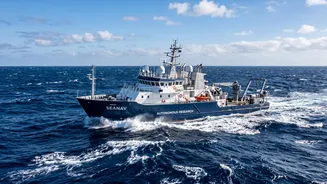
The global race to build self-driving ships promises safer, more efficient trade. Now, a breakthrough from IIT Madras called SeaNav offers a crucial solution: a way to test these complex systems without the immense cost and risk of real-world trials.
What Exactly is SeaNav?
SeaNav is a state-of-the-art digital twin platform developed by the Department of Ocean Engineering at IIT Madras. Think of it as an ultra-realistic video game for the maritime world. Built on the Unity3D engine, it creates a virtual environment that simulates ships, sensors, ocean conditions, and vessel traffic with high fidelity. This isn't just a simple simulation; SeaNav functions as a 'digital twin', meaning it creates a virtual replica of the real world that can be used for testing, validation, and training of autonomous navigation systems. By doing so, it directly addresses one of the biggest hurdles in developing self-navigating ships: the danger and expense of testing unproven algorithms on the open sea.
The High-Stakes World of Maritime Testing
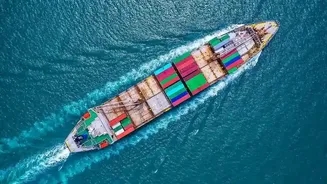
Autonomous vessels are seen as a game-changing technology for an industry that handles over 80% of world trade. By reducing human error, they have the potential to significantly enhance safety and lower operational costs. However, you can't simply upload new software to a 300-metre-long tanker and hope for the best. The real world is fraught with challenges, including unpredictable weather, complex traffic situations, and the risk of catastrophic collisions or groundings. Real-world trials are not only expensive and complex but also potentially hazardous to the crew, the vessel, and the marine environment. Furthermore, these systems must contend with imperfect information from sensors, which can be affected by fog, rain, or other factors. This makes a safe, repeatable, and cost-effective testing environment an absolute necessity.
How SeaNav Provides a Safe Harbour for Innovation
SeaNav tackles these challenges by moving the trial-and-error phase into the virtual realm. The platform has been calibrated using a benchmark tanker vessel approximately 320 metres in length, ensuring that results from the simulator closely mirror real-world commercial shipping operations. Unlike simpler simulators, SeaNav models the limitations of actual sensors, including noise and delays, forcing the AI to navigate in challenging conditions. It also features a Virtual Reality (VR) interface, allowing trainees and engineers to experience the simulation from the ship's bridge, providing realistic training for collision avoidance and emergency manoeuvres. This combination of a high_fidelity digital twin, AI, advanced sensor fusion, and VR creates a comprehensive sandbox where autonomous systems can be pushed to their limits safely.
Aligning with India's Maritime Vision
The development of SeaNav is a significant step for India's maritime ambitions. The platform aligns directly with national initiatives like the 'Sagarmala Programme' and 'Maritime India Vision 2030', both of which emphasize the importance of smart ports, digital technologies, and autonomous systems. By providing a tool to develop AI_assisted navigation, SeaNav can directly contribute to enhancing safety and efficiency at major Indian ports such as Chennai, Mumbai, Visakhapatnam, and Kochi. The project positions IIT Madras, which has been building its expertise in marine autonomous systems, as a key contributor to this national effort. Beyond commercial shipping, the platform's multi_vessel simulation capabilities have potential applications in coastal surveillance, search_and_rescue operations, and maritime defence.