





A New Era of Exploration
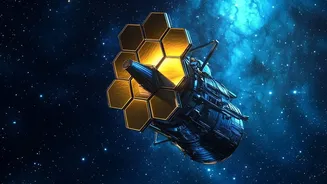
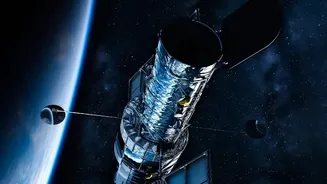
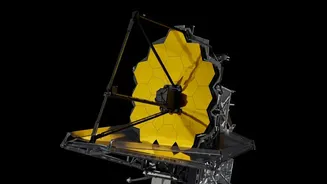
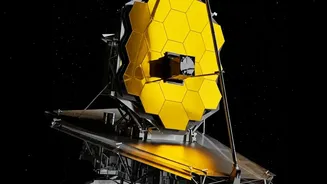
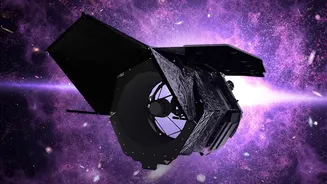
The James Webb Space Telescope represents a monumental leap forward in our ability to study the cosmos. While previous telescopes, like Hubble and Kepler, were brilliant at discovering thousands of planets outside our solar system, or exoplanets, their
primary job was detection. JWST's mission is characterization. It has been specifically designed with powerful infrared instruments that allow it to do something revolutionary: peer into the atmospheres of these distant worlds. This shift is fundamental. It's the difference between knowing a house exists from a distance and being able to look through its windows to see what's happening inside. By analyzing the light from a planet's host star as it passes through its atmosphere, Webb can decipher which gases are present light-years away. This has kicked off a new phase in astrobiology, moving beyond simply cataloging planets to actively investigating their potential for life.
How to Read an Alien Sky
The technique at the heart of this new era is called transmission spectroscopy. In simple terms, when an exoplanet passes in front of its star from our perspective, a tiny fraction of the starlight filters through the planet's atmosphere. Different gases in that atmosphere absorb light at very specific wavelengths. By capturing the starlight with and without the planet in front of it, astronomers can see which 'colors' of light are missing. These missing slivers in the spectrum act as chemical fingerprints, revealing the molecules present. For example, JWST has already confirmed the presence of water vapor, carbon dioxide, and methane in the atmospheres of various exoplanets, from hot gas giants like WASP-96b to potential 'Hycean' worlds—planets covered in deep oceans with hydrogen-rich atmospheres—like K2-18 b. This ability to identify specific gases is the first critical step in searching for biosignatures.
The Hunt for Biosignatures
A biosignature is any substance, element, or pattern that provides evidence of life. On Earth, life has completely transformed our atmosphere, filling it with gases like oxygen that wouldn't exist in such high quantities otherwise. Scientists are looking for similar tell-tale signs on other worlds. One promising approach is looking for a chemical imbalance—a mix of gases that shouldn't naturally coexist without some active process constantly replenishing them. For example, finding significant amounts of both methane and carbon dioxide could suggest a biological source constantly producing methane. More tantalizingly, JWST's observations of the exoplanet K2-18 b have shown possible hints of dimethyl sulfide (DMS), a gas that, on Earth, is overwhelmingly produced by microbial life, particularly marine phytoplankton. While these detections are still tentative and require much more verification, they represent some of the most intriguing leads yet in the search for life.
The Burden of Proof
It is crucial to understand that these tantalizing hints are not proof of alien life. The scientific standard for such a monumental discovery is incredibly high. For every potential biosignature, researchers must exhaustively rule out all possible non-biological, or abiotic, sources. Methane can be produced by geological processes. Oxygen can build up in an atmosphere through processes that have nothing to do with photosynthesis, such as when intense stellar radiation splits water molecules. Even the DMS signal on K2-18 b is far from confirmed, with some analyses suggesting the data is inconclusive. Furthermore, JWST's observations are incredibly challenging. The signals are minuscule, and interference from the host star's own activity, such as starspots, can contaminate the data and mimic atmospheric signals. Scientists caution that JWST may never provide a single, definitive 'silver bullet' discovery but will instead build a cumulative case by studying many worlds.
The Long Road Ahead
The James Webb Space Telescope has undeniably opened a new frontier. Its early findings have already reshaped our understanding of planetary diversity, revealing worlds with strange chemistries unlike anything in our solar system. It has confirmed that key ingredients for life, like water and carbon-based molecules, are present on planets in the habitable zones of their stars. However, the search for life is a marathon, not a sprint. Each observation raises new questions and refines what scientists need to look for next. The current findings, especially those concerning K2-18 b, have spurred a drive for more observation time to strengthen the statistical confidence of the detections. The telescope's data is pushing scientists to develop better models to distinguish a true biosignature from a geological quirk or an instrumental artifact. The work being done today is laying the essential groundwork for future, even more powerful observatories.