




A New Life for a Veteran Explorer
After successfully delivering precious samples from asteroid Ryugu to Earth in December 2020, the Hayabusa2 mission could have ended in a blaze of glory. Instead, with about half of its xenon fuel remaining, the Japan Aerospace Exploration Agency (JAXA)
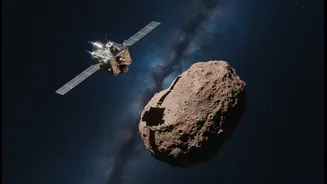
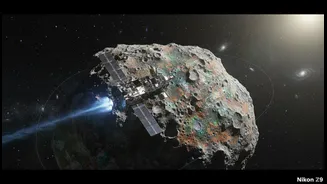
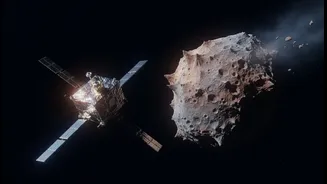
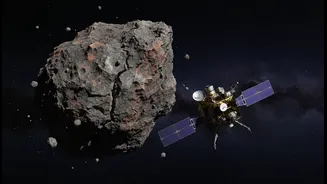
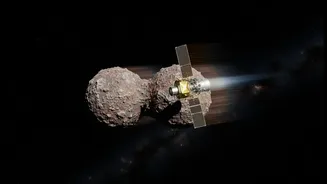
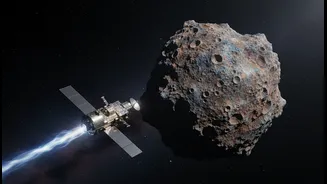
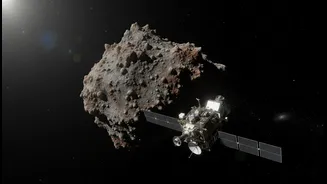
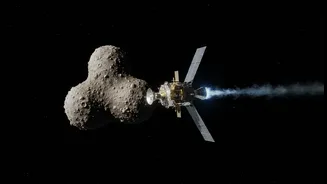
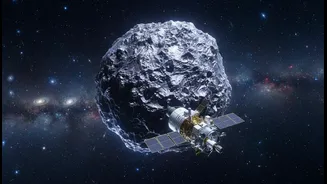
gave the probe a new lease on life: an extended mission called Hayabusa2♯ (pronounced 'sharp'). This new journey sent it hurtling back into deep space to visit two more asteroids. The first of these encounters was the high-speed flyby of a 450-meter-wide space rock named Torifune, which took place on July 5, 2026. This wasn't part of the original plan; it's a bonus objective that pushes the 12-year-old spacecraft and its navigation systems to their absolute limits.
The Challenge: A High-Speed, Low-Information Flyby
The Torifune flyby was exceptionally difficult. The spacecraft screamed past the asteroid at a relative speed of about 5 kilometers per second, or 18,000 kilometers per hour. At that velocity, there is no room for error. What makes this even more challenging is that asteroids like Torifune are dark and their exact orbits have a degree of uncertainty. JAXA mission planners noted that the spacecraft could only get a clear view of its target a few days before the encounter, requiring rapid, last-minute trajectory adjustments to avoid a collision while getting as close as possible. The probe ultimately passed just 800 meters from the asteroid's center, a testament to the team's skill. This type of operation—a rapid reconnaissance flyby—is considered a crucial skill for planetary defense.
The Masterclass in Navigation
So, how did they pull it off? It's a combination of Earth-based guidance and on-the-fly autonomy. For most of its journey, Hayabusa2 relies on communication with deep space networks on Earth. But in the final, critical days leading up to the flyby, this becomes impractical due to communication delays. The spacecraft had to switch to its own 'eyes'—its Optical Navigation Camera (ONC-T). By imaging the faint asteroid against the backdrop of stars, the probe's autonomous navigation system could calculate its own position and make the tiny, precise thruster firings needed to stay on course. This ability to perform last-minute guidance adjustments autonomously is the key lesson from this flyby. It’s the same technology that would be needed to intercept a potentially hazardous asteroid.
Why This Precision Matters
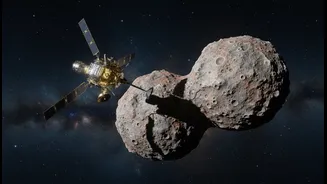
This flyby was far more than a sightseeing tour. It served as a vital technology demonstration for planetary defense. There are many asteroids the size of Torifune, and while a collision is infrequent, it would cause significant damage. Before we can deflect a threatening asteroid, we first need to be able to reach it and study it quickly. This mission tested exactly that: rapid reconnaissance and high-precision guidance. The data gathered on Torifune's snowman-like, two-lobed shape, surface temperature, and structure will help scientists understand these near-Earth objects better. It’s a dress rehearsal for a real-world scenario where we might only have a short window to analyze a threat and decide how to act. This technology is also foundational for future commercial space ventures, such as asteroid mining, which will require similar feats of precision navigation to rendezvous with and operate around small celestial bodies.
What's Next for Hayabusa2?
The Torifune encounter is just a stepping stone. Hayabusa2 is now continuing on its journey, set for two Earth swing-bys in 2027 and 2028 to adjust its trajectory. Its ultimate destination, scheduled for July 2031, is an even more challenging target: 1998 KY26. This tiny asteroid is estimated to be only about 30 meters in diameter and rotates incredibly rapidly. Exploring such a small, fast-spinning object has never been done before and will push Hayabusa2's capabilities even further. It would be the smallest asteroid ever visited up-close by a spacecraft, providing crucial insights into a class of objects that are too small to be easily tracked from Earth but large enough to cause significant damage if they were to hit a populated area.