

The Unmistakable Evening Star
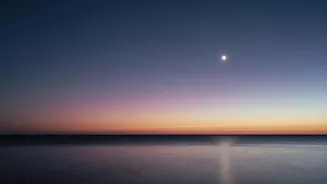
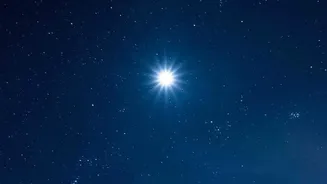
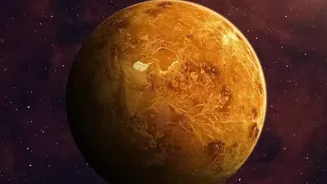
Throughout September 2026, Venus will reign as the undisputed queen of the evening sky. Often called the 'Evening Star,' it will appear as an intensely bright, steady beacon of light in the west shortly after the Sun goes down. Its brilliance is not due
to it being a star; it is a planet reflecting the Sun's light with its thick, highly reflective cloud cover. In fact, it is so bright that it is often the first celestial object to become visible after sunset and is frequently mistaken for an airplane or a drone. Unlike stars, which twinkle due to Earth's atmospheric turbulence, Venus shines with a serene and unwavering glow.
When and Where to Look from India
For observers in India, the instructions are simple. Find a location with a clear, unobstructed view of the western horizon. The best time to look is anywhere from 30 to 90 minutes after sunset. As twilight deepens, Venus will emerge as a stunningly bright point of light. Early in the month, it will be higher in the sky, setting about an hour and a half after the sun. As the month progresses, while it grows even brighter, it will also appear lower on the horizon each evening, so catching it in that window after sunset becomes more crucial. Remember to get away from the glare of city lights for the most spectacular and immersive viewing experience.
September's Celestial Highlights
September 2026 is particularly special for Venus watchers. Around September 22, the planet reaches its 'greatest brilliancy', achieving its peak brightness for the year at a dazzling magnitude of -4.8. For scale, that is many times brighter than the brightest star in the sky, Sirius. Another key date is September 14, when a thin waxing crescent Moon will make a close approach to Venus, creating a breathtaking celestial pair in the evening twilight. This lunar occultation, where the Moon passes in front of the planet, will be visible across large parts of Asia, offering a truly unique viewing opportunity. Early in the month, on September 1 and 2, Venus will also have a close conjunction with Spica, the brightest star in the constellation Virgo.
Do You Need a Telescope?
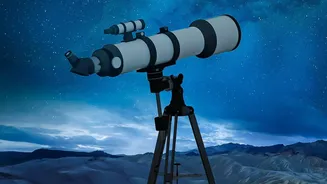
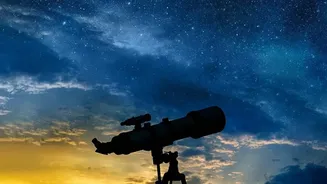
Absolutely not! Venus's spectacular brightness means it is one of the most rewarding objects to view with the naked eye. No special equipment is required to enjoy its presence. However, if you have a pair of binoculars or a small telescope, you are in for an extra treat. Pointing them at Venus will reveal that it has phases, just like our Moon. During September 2026, as Venus gets closer to Earth in its orbit, a telescope will show it as a distinct and beautiful crescent. This is a fascinating sight that confirms Venus is a world orbiting the Sun, just as Earth is.
A Nod to Shukra, The Dazzling Guru
For millennia, this bright planet has held a special significance in India. In Indian astrology and mythology, Venus is known as Shukra, the guru of the asuras (demons) and a symbol of love, beauty, wealth, and refinement. Associated with Friday (Shukravar), the planet is a powerful force in Vedic tradition. While modern astronomy explains its brilliance through the science of orbital mechanics and atmospheric composition, the sight of Shukra gleaming in the twilight connects us to a rich cultural lineage of skywatching that has spanned countless generations on the subcontinent. Spotting it in the sky is a chance to connect with both the cosmos and our own deep-rooted heritage.