



What is the Tower-Catch Strategy?
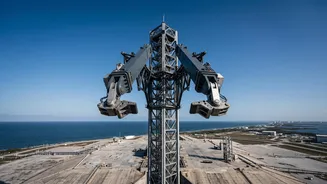
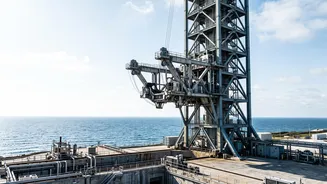
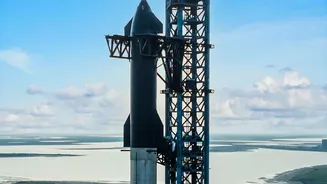
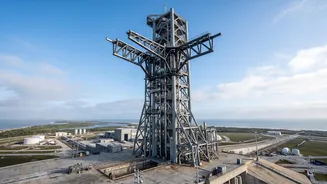
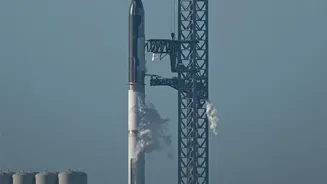
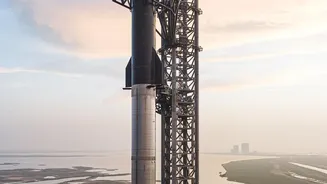
At the heart of SpaceX’s South Texas launch site stands a colossal launch and integration tower, nearly 400 feet tall. But this isn't just a static support structure. It’s an active piece of recovery hardware nicknamed 'Mechazilla'. The tower is equipped
with a set of massive, moveable arms, often called 'chopsticks', designed to do something unprecedented in the history of rocketry: catch the returning Super Heavy booster, and eventually the Starship spacecraft itself, directly out of the air. After launching and separating from the upper stage, the 232-foot-tall Super Heavy booster is designed to fly back to the launch site, fire its engines to slow its descent, and maneuver itself precisely between these arms. The arms then close, securing the booster by latching onto reinforced hardpoints near its grid fins, preventing it from ever touching the ground.
A High-Stakes Robotic Ballet
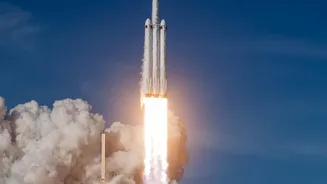
The sequence of events required for a successful catch is an engineering feat of incredible precision. After separating from the Starship upper stage, the Super Heavy booster performs a series of burns to reverse its course and target the launch tower. As it descends, it uses four large grid fins to control its orientation and trajectory. In the final moments, the booster must execute a perfect landing burn, using its Raptor engines to slow from supersonic speeds to a gentle hover. It has to arrive at exactly the right height and position relative to the tower, with near-zero velocity, allowing the hydraulically actuated arms to close and secure it. The margin for error is razor-thin. A miscalculation in timing, positioning, or engine thrust could result in the catastrophic loss of not just the booster, but the entire launch tower—the very infrastructure needed for future flights.
Why Not Just Use Landing Legs?
SpaceX already mastered landing its Falcon 9 boosters on legs, so why the radically different and riskier approach for Starship? The answer comes down to two key business drivers: mass and speed. Landing legs capable of supporting the immense Super Heavy booster would be incredibly large and heavy, potentially weighing tens of thousands of kilograms. Every kilogram dedicated to landing gear is a kilogram that can't be used for payload or fuel, directly impacting the rocket's efficiency and the cost per launch. By moving the landing hardware from the vehicle to the ground, SpaceX makes the rocket itself lighter and more efficient. More importantly, the catch strategy is the key to rapid reusability. A caught booster is already positioned at the launch mount, ready to be inspected, stacked with a new upper stage, refueled, and launched again, potentially within hours. This 'airline-like' operational tempo is the core of SpaceX's long-term vision.
The Bigger Picture for SpaceX
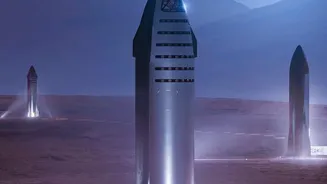
The tower-catch system is far more than just an engineering stunt; it's the fundamental enabler for SpaceX's most ambitious goals. To establish a self-sustaining city on Mars, SpaceX plans to launch fleets of Starships during planetary alignment windows, which occur only every 26 months. This requires launching a primary Starship followed by several 'tanker' Starships to refuel it in orbit—a feat demanding an extremely high launch cadence that would be impossible without rapid reusability. By catching and quickly re-flying boosters, SpaceX aims to dramatically lower the cost of putting mass into orbit, making interplanetary travel and massive point-to-point cargo delivery on Earth economically feasible. The entire business model for Starship hinges on this ability to treat rockets less like single-use machines and more like commercial airliners.
An Unforgiving Margin for Error
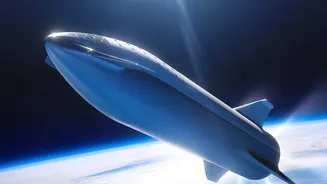
Despite the enormous potential, the tower-catch strategy carries monumental risks. A failure during the catch sequence could be devastating, destroying not only the booster but also the immensely complex and expensive launch tower, setting the program back significantly. The maneuver requires a level of automated precision that has never been attempted on this scale. While the company has already successfully caught a booster in testing, applying the same technique to the even more complex return of the Starship upper stage from orbital velocity presents a whole new set of challenges, including surviving the intense heat of reentry before attempting the catch. Analysts and even SpaceX itself acknowledge these risks, proceeding with caution and extensive data review before each new attempt. Any technical glitch with the tower's hardware or the returning rocket could trigger an abort, diverting the vehicle to a safe splashdown in the ocean instead.