


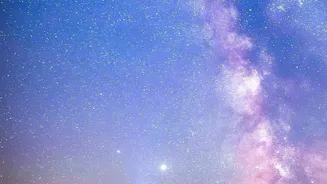
The Post-Monsoon Celestial Canvas
October marks a sweet spot for amateur astronomers across India. The departure of the monsoon washes the atmosphere clean of dust and haze, leading to enhanced transparency and darker skies. The weather is also far more pleasant for spending a few hours
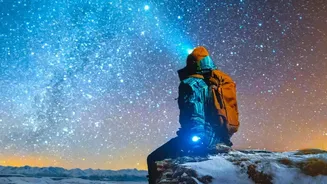
outdoors at night, with cooler temperatures and lower humidity. This combination creates the perfect conditions to lay back and soak in the wonders of the universe. You don't need expensive equipment to start; just a clear view away from city lights and a little patience. The rewards are immense, offering a chance to connect with the vastness of space from your own backyard or a nearby dark-sky spot.
A Parade of Planets
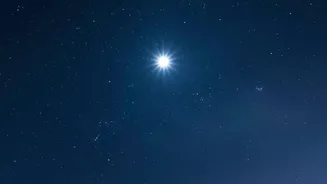
This October, several planets are putting on a show for early evening and late-night observers. The king of the planets, Jupiter, will be a brilliant, unmissable beacon in the sky. Look for it shining with a steady, commanding light. Not far behind is Saturn, which can be identified by its distinct, calmer, yellowish glow. You'll need a telescope to see its famous rings, but even with the naked eye, its presence is majestic. Mars, the Red Planet, will also be visible, distinguished by its reddish-orange hue. Its visibility will improve as the month progresses. The best way to locate them is by using a stargazing app, which can provide a real-time map of the sky from your location.
Catch Two Meteor Showers
October is famous for two reliable meteor showers. First up are the Draconids, peaking around October 8-9. This is a minor shower, but it can sometimes produce unexpected outbursts of 'falling stars'. The best part is that its peak is in the early evening, just after dusk, making it accessible for everyone. Later in the month, the Orionids take centre stage, peaking around October 21-22. The Orionids are known for their bright and speedy meteors, which are created from the dust trail of Halley's Comet. For the best view, find a dark spot away from city lights after midnight. The Moon will be in a favourable phase during the peak, meaning its light won't wash out the fainter meteors, promising a potentially great show with up to 20 meteors per hour.
Find a Distant Galaxy
Beyond our solar system, October's sky is a gateway to deep-space treasures. The most famous target is the Andromeda Galaxy (M31). This is the most distant object you can see with the naked eye, appearing as a faint, fuzzy smudge of light in the constellation Andromeda. To find it, first locate the Great Square of Pegasus, a large square of four bright stars high in the eastern sky after sunset. From the corner star of the square that is part of Andromeda, you can star-hop your way to the galaxy. Seeing this island of over a trillion stars, whose light has travelled for 2.5 million years to reach you, is a truly humbling experience. Binoculars will make it much easier to spot and will reveal its elongated shape.
Your Stargazing Toolkit
Getting started is simple. First, download a reliable stargazing app like Stellarium, SkyView, or Star Walk. These apps use your phone's GPS to show you exactly what you're looking at in the night sky. Second, escape light pollution. The darker your location, the more you will see. Even travelling 30 minutes outside a major city can make a huge difference. Third, give your eyes time to adapt. It takes about 20-30 minutes for your eyes to become fully sensitive to the dark, so avoid looking at your bright phone screen. Use the red-light mode on your app if it has one. While a telescope is a fantastic tool, a simple pair of binoculars is a great starting point for viewing the Moon's craters, the moons of Jupiter, and getting a better look at star clusters and the Andromeda Galaxy.