







The Dawn of a Private Space Race
The global space economy is undergoing a monumental shift. Once the exclusive domain of national space agencies, the cosmos is now open for business. This has ignited a new kind of race to the Moon, one driven not just by national prestige, but by commercial
opportunity. The Moon is seen as a crucial stepping stone for deeper space exploration and a potential source of valuable resources. This has created a surging demand for reliable and affordable lunar logistics, including landers, satellites, and rovers capable of navigating the harsh lunar surface. Riding this wave, India's private space sector has expanded significantly, with over 400 startups now operating in the country. Bolstered by the Indian Space Policy 2023, these companies are leveraging government support, technology transfers from ISRO, and a burgeoning pool of engineering talent to aim for the Moon and beyond.
Meet India's Lunar Pioneers
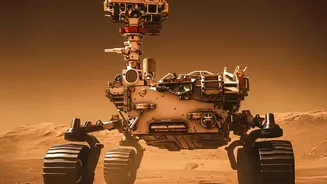
At the forefront of this commercial push is Bengaluru-based Axiom Research Labs, the company that began as TeamIndus. Originally formed to compete in the Google Lunar XPRIZE, the company has developed significant expertise in lunar systems. Their rover, named ECA for 'Ek Choti Si Asha' (A Small Hope), was designed as a lightweight vehicle for surface exploration. While the XPRIZE competition ended without a winner, the experience provided a crucial foundation. The company has since been involved in international consortiums, including a partnership with US-based OrbitBeyond for a NASA commercial payload contract, demonstrating its capabilities on a global stage. Other players are also emerging. While some startups focus on satellites and launch vehicles, the foundational work on rovers and landers by pioneers like Axiom has paved the way for a broader ecosystem. The Indian government has actively encouraged this growth through initiatives like IN-SPACe, which facilitates access to ISRO facilities and technical mentorship.
The 'Frugal Innovation' Advantage
India's reputation for 'frugal innovation' in space, famously demonstrated by ISRO's cost-effective missions, is a key advantage for its private sector. Startups are adopting a similar mindset to build low-cost rovers. This affordability is achieved not by cutting corners, but through a combination of strategic advantages. Using local manufacturing and supply chains reduces dependency on expensive imported components. Furthermore, a focus on smaller, more efficient designs and the use of qualified, off-the-shelf parts where possible helps keep development costs down. The government's policy of offering discounted access to ISRO's world-class testing and validation facilities is another critical factor. This allows startups to avoid the massive capital expenditure required to build their own testing infrastructure, directly translating into lower operational costs and a more competitive final product. This model aims to position India as a go-to destination for affordable lunar surface mobility.
Ready for Commercial Liftoff?
The phrase "ready for commercial missions" marks a crucial transition from development to deployment. For these Indian startups, it means their rovers have reached a level of technological maturity where they can be offered to a global market of customers, including foreign space agencies, scientific institutions, and other private companies planning lunar missions. The business model is often 'rover-as-a-service,' where a customer pays to have their scientific instrument or technology payload operated on the lunar surface. The Indian government is actively fostering this transition with a liberalized Foreign Direct Investment (FDI) policy and the creation of venture capital funds to support space startups. NewSpace India Limited (NSIL), ISRO's commercial arm, plays a vital role by transferring proven technologies to industry, reducing the research and development burden on new companies. The challenge now lies in securing a spot on a lunar lander, a competitive market in itself. With numerous lunar missions planned globally over the next decade, the opportunities are there for the taking.