



Two Goals, One Mission
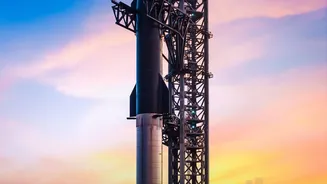
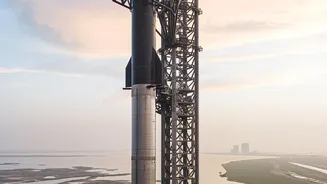
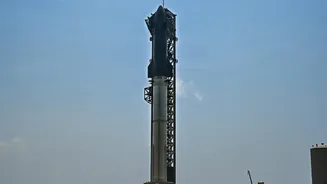
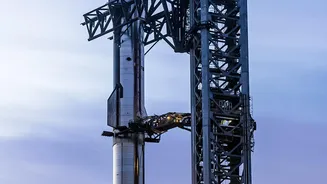
The primary objective for Starship's Flight 15 was arguably the most ambitious in modern rocketry: to launch to orbit and then recover both the Super Heavy booster and the Starship upper stage by catching them with the launch tower's giant mechanical
arms, nicknamed 'Mechazilla'. This 'double catch' had never been attempted. A successful demonstration would be the 'holy grail of spaceflight', proving a path to rapid and full reusability, which is the core of SpaceX's plan to dramatically lower the cost of accessing space and, eventually, to build a city on Mars. On top of this, the flight also aimed to deliver another batch of Starlink satellites into low Earth orbit.
A Flawless Ascent and a Fiery Setback
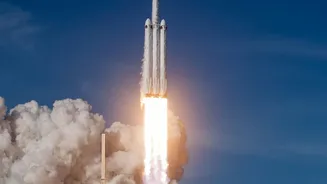
The mission began with a picture-perfect liftoff from Starbase in Texas, as the 33 Raptor engines on the Super Heavy booster roared to life, pushing the world's largest rocket toward the sky. After a clean 'hot-staging' separation, where the Starship's own engines ignited to push it away from the booster, the mission split into two distinct stories. The Super Heavy booster began its automated return sequence. However, an issue during its boostback burn, reportedly a low fuel mass alarm, triggered a safety abort. Instead of heading for the launch tower, the booster was diverted to a safe zone over the Gulf of Mexico, where its flight was terminated in an explosion just before hitting the water.
Starship's Historic Journey to Orbit
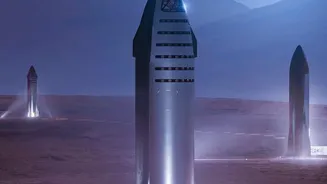
While the booster's journey ended prematurely, the Starship upper stage, known as Ship 42, continued flawlessly. It successfully achieved its orbital insertion burn, marking only the second time a Starship had reached Earth orbit. The vehicle spent the next 22.5 hours in space, completing 14 full orbits of the planet. During this time, it accomplished a key secondary mission: successfully deploying a payload of 26 advanced Starlink internet satellites. This long-duration flight provided SpaceX with invaluable data on the vehicle's performance in the harsh environment of space.
The Catch Seen Around the World
After nearly a day in orbit, Ship 42 began its return. Following a deorbit burn, the spacecraft plunged back into the atmosphere, protected by its thousands of heat-shield tiles. The world watched as live cameras showed the vehicle performing its signature 'belly-flop' maneuver to slow down before reigniting its Raptor engines for a final landing burn. In the final, nail-biting moments, the massive spacecraft precisely positioned itself between the waiting 'chopstick' arms of the Mechazilla tower, which closed around it, completing the first-ever catch of an orbital-class upper stage. The historic achievement was met with roaring cheers at SpaceX mission control.
A Giant Leap Forward, Despite the Loss
The loss of the Super Heavy booster was a notable setback, preventing the full 'double catch' demonstration. However, the mission is being hailed as a monumental success. Catching the Starship upper stage is the single most critical step toward making the system fully and rapidly reusable. It proves the viability of a concept that eliminates the need for heavy landing legs and allows for a quicker turnaround, treating the rocket more like an airplane. SpaceX founder Elon Musk inspected the returned ship and noted it looked to be in great condition, suggesting it could be refurbished for another flight in just a few weeks. For SpaceX, where data from failures is as valuable as success, Flight 15 provided both, accelerating the path toward its ultimate goals.