






Our Restless Star
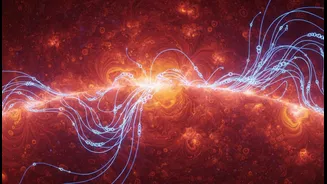
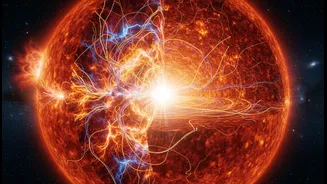
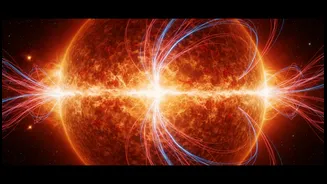
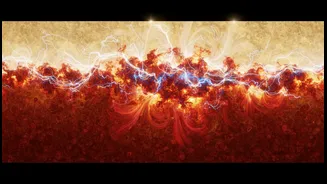
The Sun is not a static, unchanging ball of fire. It's a churning, turbulent sphere of super-hot gas governed by powerful magnetic fields. This activity isn't just a distant spectacle; it generates 'space weather' in the form of solar flares and coronal
mass ejections (CMEs). These eruptions blast enormous amounts of energy and charged particles into space. When aimed at Earth, they can disrupt satellite communications, damage power grids, endanger astronauts, and interfere with GPS navigation systems. Understanding what drives these events is crucial for protecting our increasingly technology-dependent world. For years, scientists have looked deep inside the Sun for answers, and now, a key piece of the puzzle is coming into focus.
Inside the Sun: The Tachocline
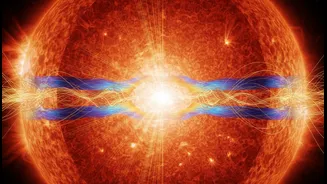
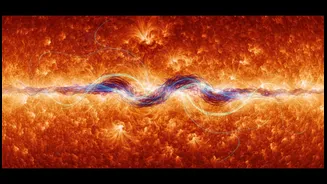
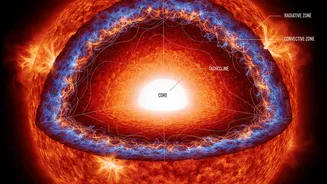
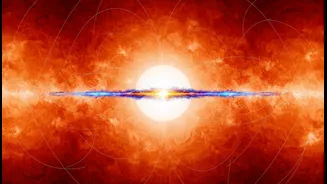
To understand solar eruptions, we have to look at the Sun's internal structure. It has a core, a radiative zone, and a convective zone. Sandwiched between the radiative and convective zones is a remarkably thin but critical boundary layer called the tachocline. This layer is fascinating because it marks a dramatic change in the Sun's rotation. The radiative interior rotates like a solid object, while the outer convective zone spins differently, with the equator rotating faster than the poles. The tachocline is the shear layer where these two distinct rotation styles meet. Scientists have long believed this region is the primary generator for the Sun's magnetic field, acting as a magnetic dynamo that powers the entire solar cycle.
The COFFIES Project
Unraveling the secrets of the Sun's interior requires immense computational power. This is where the COFFIES (Consequences of Fields and Flows in the Interior and Exterior of the Sun) project comes in. It's a NASA-funded DRIVE Science Center that brings together experts from over a dozen institutions to create comprehensive models of solar dynamics. The primary goal is to understand how the plasma flows inside the Sun generate its magnetic field and drive the roughly 11-year solar activity cycle. One of the biggest mysteries the COFFIES team has been tackling is the tachocline itself. Previous models struggled to explain why this shear layer is so incredibly thin—less than 5% of the Sun's radius—a puzzle that has stumped solar physicists for decades.
A Breakthrough in Understanding
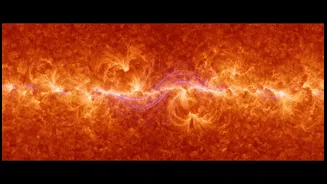
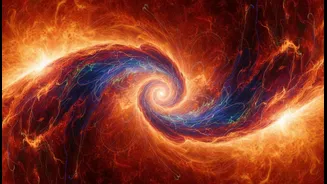
Recent work from the COFFIES team has produced a major breakthrough. By refining state-of-the-art computer simulations, researchers have developed a model that finally explains the tachocline's signature thinness. The new model shows a complex interplay where a fluctuating magnetic field is the key to confining the layer and keeping it thin. In this scenario, the tachocline plays its essential role in amplifying and organizing the magnetic field, which is the engine behind solar activity. It is believed to store and then release magnetic energy, which rises to the surface to form sunspots. These sunspot regions are the launchpads for solar flares and CMEs, the very phenomena that create space weather.
Why This Finding Matters for Earth
This discovery isn't just an academic curiosity. By understanding the fundamental physics of how the tachocline works, scientists can significantly improve their ability to predict space weather. Knowing when a major solar eruption might occur gives satellite operators, power grid managers, and airlines crucial time to take protective measures. For example, satellites can be put into a safe mode, and power grids can be reconfigured to prevent overload. This new insight into the Sun's magnetic engine brings us one step closer to reliable forecasts, enhancing the safety and stability of our technological infrastructure. It demonstrates how studying a thin, invisible layer nearly 93 million miles away has direct and tangible benefits for life on Earth.