



The Challenge of Hitting the Brakes
Getting into orbit around Mercury is counterintuitively one of the hardest tasks in the solar system. While it's relatively close, any spacecraft traveling from Earth is constantly being pulled by the Sun's immense gravity. The closer you get to the Sun,
the faster you go. To avoid screaming past Mercury and getting pulled into the Sun, a spacecraft needs to perform a massive braking maneuver. The amount of conventional rocket fuel needed for such a burn would be enormous, making the spacecraft too heavy to launch efficiently. This gravitational challenge is why only two missions, NASA's Mariner 10 and MESSENGER, have visited Mercury before BepiColombo.
A Journey of a Billion Brakes
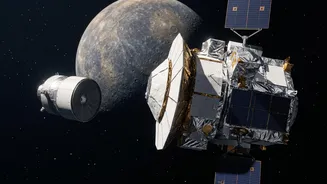
The joint European Space Agency (ESA) and Japan Aerospace Exploration Agency (JAXA) mission solved this problem with a combination of patience and clever physics. Instead of one giant burn, BepiColombo has spent its long cruise using two techniques. First, it performed nine planetary gravity-assist flybys: one of Earth, two of Venus, and six of Mercury itself. Each flyby used the planet's gravity to shed speed and carefully adjust its trajectory. Second, the spacecraft has been powered by an advanced solar electric propulsion system. This system uses solar energy to ionize xenon gas, creating a gentle but highly efficient stream of ions that provides a constant, low-level thrust over months and years to continuously slow the spacecraft down.
The Grand Finale: A Six-Month Arrival
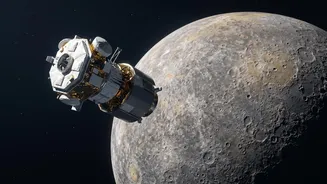
The arrival isn't a single event but a carefully choreographed six-month sequence that began on September 3, 2026, with the separation of the Mercury Transfer Module (MTM), the component that provided propulsion for the cruise. The two science orbiters, still stacked together, will then be weakly captured by Mercury's gravity around November 21, 2026. This will be followed by a series of 16 separate maneuvers to progressively lower and shape their orbits. This delicate, multi-step process is necessary because of the planet’s weak gravity and proximity to the Sun. A thruster issue discovered in 2024 necessitated a revised, lower-thrust trajectory, delaying the final arrival from 2025 to late 2026 but keeping the science objectives intact.
Two Spacecraft, Two Complementary Orbits
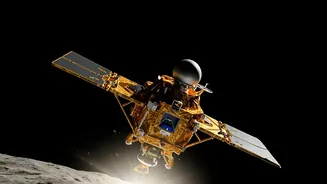
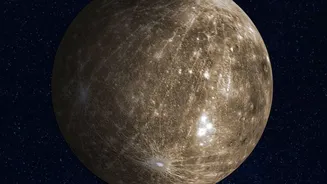
The entire point of this intricate arrival is to place two separate orbiters into two very different, but complementary, scientific orbits. In December 2026, JAXA’s Mercury Magnetospheric Orbiter (Mio) will separate and enter a wide, elliptical orbit. Its primary mission is to study Mercury's magnetic field and its interaction with the solar wind. A few months later, in March 2027, ESA’s Mercury Planetary Orbiter (MPO) will reach its final, much tighter, low-altitude orbit. From this close-up vantage point, the MPO will map the planet’s surface, study its geology and craters, and investigate its internal composition. This dual-spacecraft approach provides simultaneous measurements from different locations, a first for Mercury exploration.
Unlocking Mercury's Secrets
The specific orbits achieved through this long arrival sequence are directly tied to the mission's core science goals. Scientists want to understand why Mercury, a planet not much bigger than our Moon, has a global magnetic field while Venus and Mars do not. They also want to investigate mysterious ice deposits found in permanently shadowed craters at the poles, despite surface temperatures that can reach 450°C. By studying Mercury's unusually large iron core and its evolution so close to a star, BepiColombo will provide crucial insights into how our entire solar system formed. The precision of the final orbits is what makes it possible for the instruments to gather the high-quality data needed to answer these profound questions.