


The Primary Suspect: A Hidden Ocean
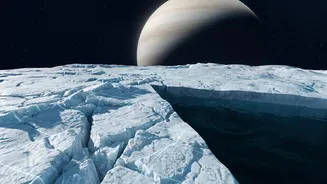
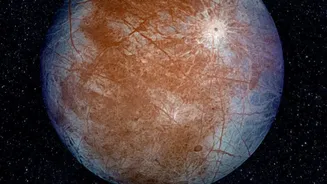
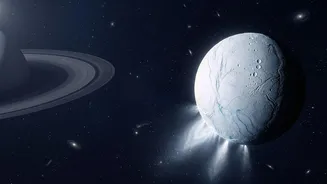
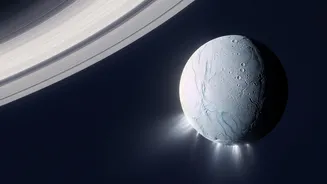
Scientists have compelling evidence that Europa, a world slightly smaller than Earth's moon, hides a global ocean containing twice as much water as all of Earth's oceans combined. This makes it one of the most promising places in our solar system to search
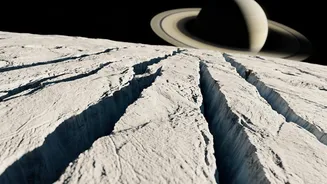
for the ingredients of life. But a critical piece of the puzzle is the ice shell that separates this potential habitat from the surface. The thickness of this crust could be anywhere from a few kilometres to tens of kilometres, a massive variable that impacts the possibility of material exchange between the surface and the ocean below. Understanding this thickness is a primary objective for the Europa Clipper mission, as it will help determine if the ocean is truly a habitable environment.
The Main Tool: REASON Radar
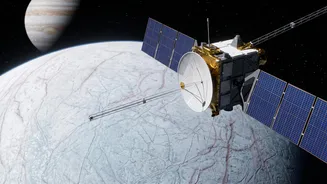
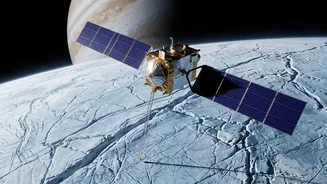
The star instrument for peering into the ice is called REASON, which stands for Radar for Europa Assessment and Sounding: Ocean to Near-surface. It is the only instrument aboard the spacecraft that can look directly through the ice. REASON is a sophisticated ice-penetrating radar, based on technology developed to study Antarctica's own massive ice sheets here on Earth. It works by sending radio waves of two different frequencies (9 MHz and 60 MHz) from large antennas mounted on the spacecraft's solar arrays. These radio waves are designed to penetrate deep into Europa's frozen crust, potentially reaching all the way to the ocean below, which could be as deep as 30 kilometres.
How It Pierces the Ice
Think of REASON as a highly advanced form of sonar or echolocation. The instrument sends out a pulse of radio energy, which travels down through the ice. When these waves encounter a change in material—such as the boundary between ice and liquid water, or a pocket of slushy brine trapped within the shell—they bounce back. The instrument's antennas then 'listen' for these echoes. By precisely measuring the time it takes for the signals to return, scientists can calculate the depth of these features. The higher frequency waves are good for mapping the upper layers and any internal structure in high detail, while the lower frequency waves are designed to penetrate deeper and, hopefully, detect the reflection from the top of the ocean itself.
The Backup Method: Gravity Science
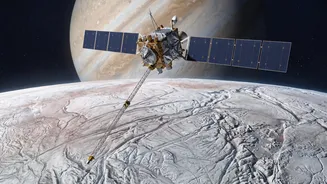
To get a complete picture, NASA isn't relying on just one method. Europa Clipper will also use gravity science to get a second opinion on the ice shell's thickness. As the spacecraft flies by Europa, its trajectory is subtly tugged by the moon's gravity. By tracking these minute changes in the spacecraft's path with Earth-based radio antennas, scientists can map Europa's gravity field. Jupiter's immense gravity also causes Europa to flex and stretch as it orbits. How much the moon deforms depends on what's inside it. A thick, solid ice shell will flex differently than a thin shell floating on a liquid ocean. Measuring this tidal flexing gives scientists another way to constrain the ice thickness and ocean depth, providing a crucial cross-check for the radar data from REASON.
A Symphony of Instruments
While REASON and the gravity science experiment are the primary tools for measuring crust thickness, they work in concert with other instruments. A magnetometer will measure the magnetic field induced within Europa's salty ocean by Jupiter's powerful magnetosphere, which also provides clues to the ocean's depth and the ice shell's thickness. Meanwhile, a thermal imager will search for hotspots on the surface that might indicate areas where the ice is thinner or warmer water from below has recently erupted. Together, this suite of advanced instruments will provide a multi-layered understanding of this enigmatic world.