


The Cosmic Eye Stares Back
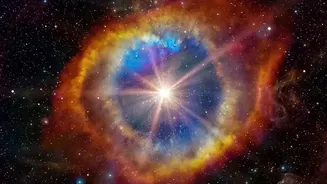
Located about 650 light-years away, the Helix Nebula is one of the closest and most striking examples of a planetary nebula. Despite the name, it has nothing to do with planets; early astronomers thought its round, hazy shape resembled a gas giant. In
reality, it's the beautiful remnants of a star, similar to our own Sun, in its final life stages. Over thousands of years, the dying star has shed its outer layers of gas, creating an expanding bubble in space. Its appearance has earned it the popular nickname, the "Eye of God." For decades, telescopes on the ground and in space have studied it, but many of its finer structures remained a mystery.
Seeing the Unseen with Webb
Previous images, like those from the Hubble Space Telescope, showed the Helix Nebula as an ethereal, ghostly structure. But the James Webb Space Telescope sees the universe in infrared light, allowing it to pierce through obscuring gas and dust to capture details hidden from view. Webb's Near-Infrared Camera (NIRCam) has provided the sharpest and most detailed infrared look at the nebula to date. The new view reveals the intricate, filamentary structure of the gas with incredible clarity. What once looked like a soft glow is now resolved into thousands of individual tendrils and clumps, showing the stark transition from hot gas near the star to cooler material farther out.
The Mystery of the 'Cometary Knots'
At the heart of this new revelation are thousands of features called "cometary knots." These aren't actual comets, but dense, tadpole-shaped clumps of gas and dust, each roughly the mass of the Earth but spanning an area larger than our solar system. For years, scientists have puzzled over how these knots form and, more importantly, how they survive the intense radiation and blistering stellar winds blasting from the central dying star. Webb's image finally provides an answer: it shows these knots in unprecedented detail, revealing how the outbound stellar winds are crashing into colder gas shed by the star earlier in its life. This collision sculpts the material, creating the comet-like tails of molecular gas that stream away from the dense, protective heads of the knots. This dynamic process—a fast-moving wind hitting a slower-moving shell—is the cosmic engine shaping the entire nebula.
A Preview of Our Solar System's Fate
Beyond its sheer beauty, the Helix Nebula provides a profound glimpse into our own distant future. In about five billion years, our Sun will exhaust its nuclear fuel and go through a similar process, puffing off its outer layers to create its own planetary nebula. The Earth and other planets will be gone, but the material that once formed our solar system will be recycled back into the cosmos. By studying the intricate physics of the Helix Nebula—how a dying star sheds its mass and enriches the space around it—scientists are essentially reading a roadmap of our Sun's final act. These stunning images aren't just snapshots of a faraway object; they are a detailed look at the life cycle of stars and the origin of the raw materials that will one day form new stars and planets.