



The Monsoon Challenge for Solar Power
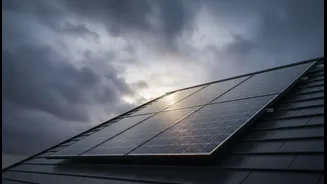
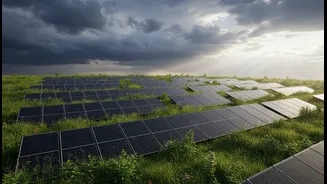
Solar energy is a cornerstone of India's renewable future, but it has a well-known vulnerability: the weather. On bright, sunny days, photovoltaic (PV) panels work at their peak. However, during the prolonged monsoon season, which blankets large parts
of the country for months, the situation changes dramatically. Heavy cloud cover severely reduces the amount of direct sunlight reaching the panels, causing a significant drop in electricity generation. This drop, which can be anywhere from 15% to over 50% on heavily overcast days, often coincides with periods when consistent power is needed most. While panels can still produce some energy from diffuse light, the reduced output puts a strain on the grid and undermines the reliability of solar as a primary power source, especially in a country banking on it for energy independence.
An All-Weather Solution
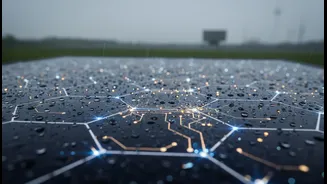
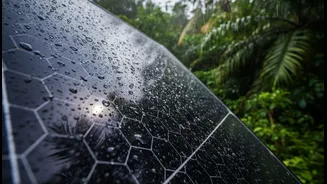
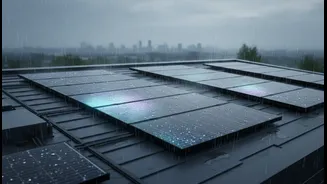
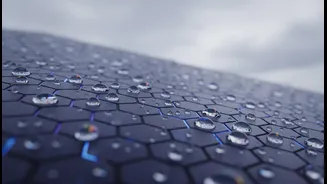
Imagine a solar panel that welcomes the rain instead of just enduring it. This is the promise of new hybrid solar cells being developed in labs around the world. The core innovation involves combining a standard solar cell with a device called a triboelectric nanogenerator, or TENG. This creates a single, integrated panel that can harvest energy from two different sources: sunlight and the mechanical energy of falling raindrops. The result is an all-weather system that continues to generate electricity during the day, whether it is sunny or rainy, and can even produce power from rainfall at night.
Harvesting Energy from Raindrops
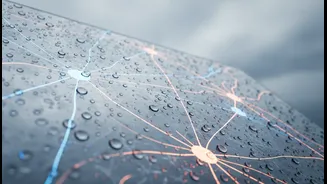
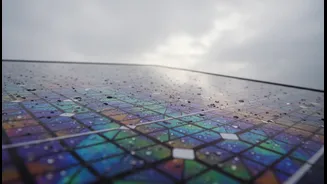
The science behind generating power from rain sounds complex but is based on a simple principle: static electricity. A TENG is made of two special polymer layers placed on top of the conventional solar cell. These materials are chosen for their opposite tendencies to gain or lose electrons. When a raindrop hits the top layer and rolls across its surface, the friction causes a transfer of electrons, creating a positive charge in the water droplet and a negative charge on the panel's surface. This difference in charge creates a small but usable electric current, which the nanogenerator captures and converts into electricity. In essence, the panel harvests the kinetic energy of the falling rain, turning a weather-related problem into a power-generating opportunity.
From Laboratory to Rooftop
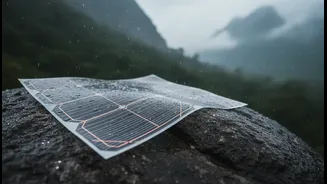
While the concept is revolutionary, these all-weather solar panels are still in the early stages of development. Researchers at institutions like China's Soochow University and Spain's Institute of Materials Science of Seville have created successful laboratory prototypes. Some have demonstrated the ability to generate a surprisingly high voltage from a single raindrop, enough to power small electronic devices like LEDs. However, significant challenges remain before they can be deployed on a mass scale. The key hurdles include improving the overall power output from rain, ensuring the long-term durability of the TENG layers under harsh weather conditions, and, most importantly, bringing down the manufacturing cost to make them economically competitive with conventional panels. Experts estimate it could be three to five years before commercial prototypes become widely available.
The Impact for India's Energy Future
For India, the potential of this technology is immense. A reliable all-weather solar panel could significantly boost the country's energy security and accelerate its transition to renewables. It would make solar power a more consistent and dependable source, particularly during the monsoon months, reducing reliance on the grid and fossil fuels. In rural and remote areas, such panels could provide a lifeline, offering uninterrupted power for homes, schools, and health centres, even during heavy rains. While the power generated from rain is currently modest compared to that from bright sunlight, it provides a crucial supplement that enhances overall system reliability. As the technology matures and efficiency improves, it could transform India's energy landscape, making solar power a truly 24/7, all-season solution.