
Decoding the Name
The name 3I/ATLAS might sound like a string of technical jargon, but it’s actually a simple code. The '3I' tells us this is the third interstellar object ever confirmed by astronomers. The 'I' stands for 'interstellar', meaning it originated from outside
our own solar system. The 'ATLAS' part of the name comes from the telescope that discovered it: the Asteroid Terrestrial-impact Last Alert System. This powerful survey, funded by NASA, scans the sky every night to find moving objects, and on July 1, 2025, it spotted this unique traveller. So, the name is essentially its birth certificate: the third interstellar visitor, found by ATLAS.
A Trio of Cosmic Travellers
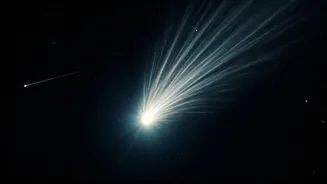
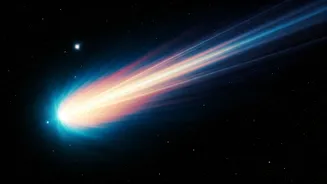
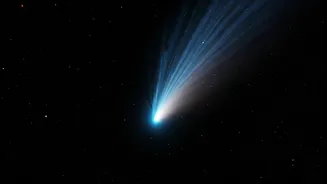
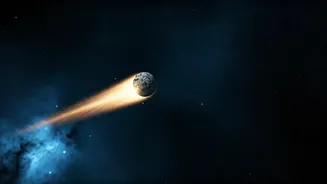
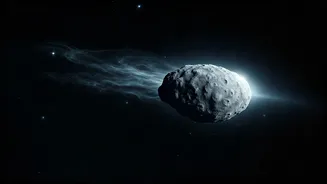
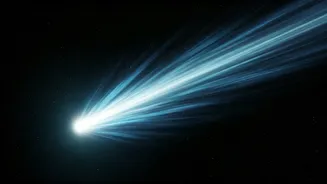
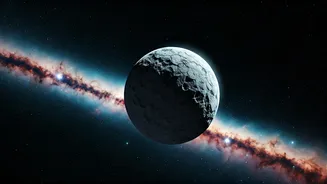
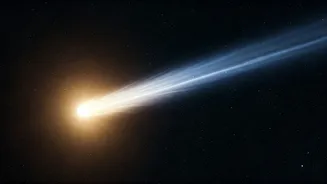
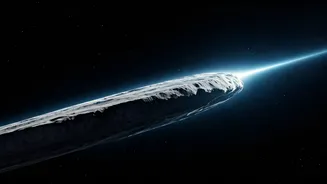
3I/ATLAS is not the first visitor we’ve had. It follows two previous discoveries that changed our understanding of the cosmos. The first, 1I/'Oumuamua, detected in 2017, was a complete mystery. It was a dark, reddish, and highly elongated object that didn't have the gassy halo, or coma, typical of a comet. Then in 2019 came 2I/Borisov, which looked and behaved much more like the comets from our own solar system, complete with a fuzzy coma and tail. 3I/ATLAS has been confirmed to be a comet, similar to Borisov. It has an icy nucleus and released a cloud of gas and dust as it was warmed by our Sun, giving scientists a precious opportunity to study its composition.
The Incredible Journey of 3I/ATLAS
This comet travelled for millions, perhaps billions, of years through the vast emptiness between stars before entering our solar system. It was discovered on a path that originated from the direction of the constellation Sagittarius. Unlike planets or local asteroids that circle our Sun in predictable ellipses, 3I/ATLAS travelled on a hyperbolic trajectory. This means it was moving so fast that our Sun’s gravity couldn't capture it into a stable orbit. It was just passing through. The comet made its closest approach to the Sun on October 29, 2025, and to Earth on December 19, 2025, though it remained a very safe distance away at all times. Having completed its brief tour, it is now heading back out into deep space, never to be seen by humanity again.
A Messenger From Another World
The excitement around 3I/ATLAS comes from what it represents: a physical sample from another planetary system. Everything in our solar system—from the Sun to Earth to the comets in our own backyard—formed from the same cloud of material. 3I/ATLAS is different. It’s a genuine outsider, carrying clues about the chemical makeup of its distant home. By using powerful instruments like the James Webb Space Telescope, astronomers analyzed the light from its gas and dust to understand what it's made of. Early studies suggest it formed in a very cold region of its home system. Some analyses even propose it could be incredibly ancient, perhaps as old as 11 billion years, making it one of the oldest objects ever observed up close.
The Search for More Visitors
For a long time, interstellar objects were just a theory. Now, with three confirmed detections in under a decade, we know they are out there, and more are coming. The discovery of 3I/ATLAS has energized the astronomical community, which is now preparing for a flood of new visitors. This is thanks in large part to new technology like the Vera C. Rubin Observatory in Chile. This next-generation facility will survey the entire sky with unprecedented depth and speed, and scientists predict it could find dozens of interstellar objects every year. What was once a once-in-a-lifetime discovery is about to become a regular occurrence, opening a new window into the countless other star systems across our galaxy.