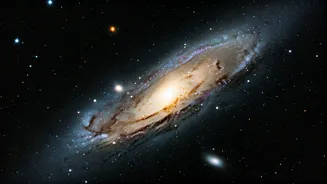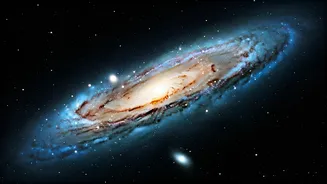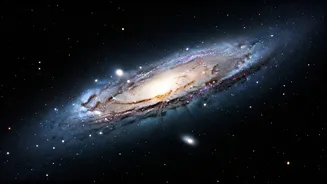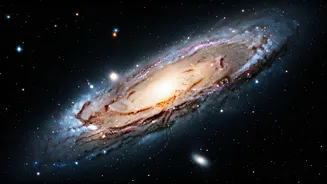



Meet the Cigar Galaxy
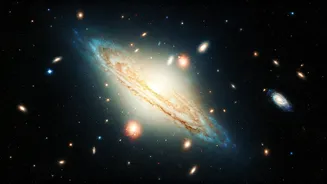
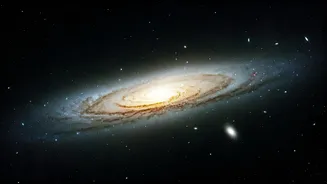
Messier 82, more commonly called the Cigar Galaxy for its elongated shape from our vantage point, is a cosmic spectacle located in the constellation Ursa Major. Discovered in 1774 by Johann Elert Bode, it’s one of the closest and most vivid examples of a “starburst”
galaxy. This means it’s undergoing a period of intense and rapid star formation. Imagine the entire star production of our own Milky Way galaxy, and then multiply it by ten—that’s the rate at which M82 is churning out new suns in its core. This frantic activity makes it about five times more luminous than our own galaxy.
A Cosmic Tug-of-War
This intense star-making frenzy isn't happening in isolation. M82 is locked in a gravitational dance with its much larger neighbor, the spiral galaxy Messier 81. Over the past few hundred million years, their interactions have sent vast streams of gas pouring into the core of M82, providing the raw fuel for its spectacular starburst. This gravitational tug-of-war has warped and distorted M82, triggering the compression of gas clouds and igniting the birth of millions of stars in dense clusters. This makes M82 a perfect, albeit temporary, laboratory for studying how galactic interactions can drive evolution on a massive scale.
The Webb Telescope's New View
For decades, thick clouds of cosmic dust have shrouded M82’s heart, preventing a clear view of the processes within. That has all changed thanks to the James Webb Space Telescope (JWST). Its powerful infrared instruments can pierce through the dust, providing an unprecedentedly clear view. In a recent survey, Webb spent 65 hours observing M82, resolving an incredible 16.5 million individual stars. These new images reveal the galaxy's true structure, including previously hidden spiral arms and a distorted, asymmetrical disk, which are tell-tale signs of its violent past interactions.
Fire and Wind
The starburst in M82 is so powerful that it's blowing out massive plumes of material. The combined energy from thousands of young, massive stars and frequent supernovae creates a galactic “superwind.” This wind, moving at over 3 million kilometers per hour, blasts hot gas and heavy elements far out of the galaxy into intergalactic space. Webb’s observations show these outflows in stunning detail, revealing a layered, hourglass-shaped structure of gas and dust extending far above and below the galactic disk. This process enriches the void between galaxies with the building blocks for future generations of stars and planets.
A Short-Lived Spectacle
As spectacular as it is, M82's starburst phase is fleeting in cosmic terms. The same incredible energy that fuels the creation of stars will ultimately bring it to an end. The superwind is blowing away the very gas needed for future star formation, and the current reserves are expected to be consumed or dispersed within a few tens of millions of years. For astronomers, M82 is a crucial snapshot of a key phase in galaxy evolution. By combining Webb’s new, sharp images with data from other observatories like Hubble, scientists can piece together the fossil record of this beautiful, messy, and wonderfully complex system, offering insights into how galaxies grow and change throughout the universe.