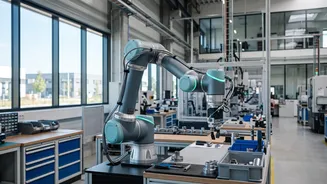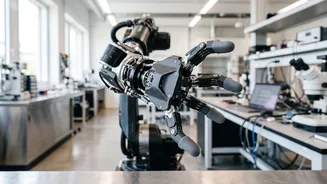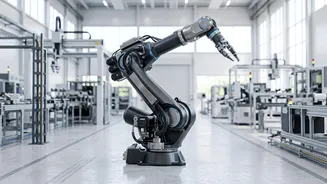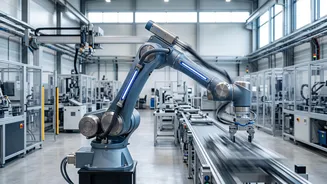






Eka Robotics, a startup focused on intelligent automation, has just secured a major $150 million funding round. This isn't just about building more robots; it's about making them smart and safe enough to work directly with people.
A Landmark Funding Round
Eka Robotics announced
the closure of a $150 million Series A funding round, a significant event that values the company at $1.45 billion. The investment was co-led by prominent venture capital firms Andreessen Horowitz (a16z) and F-Prime, which is affiliated with Fidelity Investments' parent company. The round also saw continued participation from seed investors like Obvious Ventures and E14 Fund, along with new backers including Samsung Next and several strategic corporate partners. This massive infusion of capital signals strong investor confidence in Eka's vision for the future of physical work and its potential to disrupt the industrial robotics landscape.
Redefining Human-Robot Collaboration
For decades, industrial robots have been powerful but dangerous, confined to cages to protect human workers. Eka Robotics is part of a new wave of companies developing 'cobots', or collaborative robots, designed to break free from these constraints. The primary focus of this new funding is to enhance the safety and capability of robots that operate in close proximity to people. Unlike traditional robots that are programmed for a single, repetitive task, Eka's systems are built to be general-purpose, adaptable, and, most importantly, safe enough for direct interaction. This approach is critical as industries from manufacturing to logistics seek more flexible automation solutions.
The Technology Behind the Safety
Eka's core innovation is its 'Vision-Force-Action' (VFA) model. While many robotic systems rely heavily on vision, Eka integrates force feedback as a primary sense, allowing its robots to 'feel' their way through a task. This means a robot can detect a slipping grip or an unexpected obstacle and adjust its actions in real-time, much like a human would. The company trains its AI models using reinforcement learning in a physics simulator, which allows for rapid development without the limitations of mimicking human demonstrations. This approach not only makes the robots more adaptable but also inherently safer, as they can build an 'intuition' for physical interaction.
The Growing Market in India
The push for advanced automation is accelerating in India, driven by initiatives like 'Make in India' and the broader shift toward Industry 4.0. The Indian collaborative robot market, valued at over $140 million in 2025, is projected to grow at a compound annual growth rate of over 29%, potentially reaching nearly $690 million by 2031. Key sectors like automotive, electronics, and pharmaceuticals are increasingly adopting cobots to improve productivity, ensure quality, and enhance worker safety. Eka's focus on versatile, safe, and dexterous robots positions it well to capture a significant share of this expanding market, where there's a growing need for automation that can handle complex, high-mix assembly and material handling tasks.
What’s Next for Eka Robotics?
With the new capital, Eka Robotics plans to scale its technology and accelerate customer deployments. The primary goals are to expand the capabilities of its VFA model to handle a wider array of tasks and to translate its advanced research into reliable performance in real-world industrial operations. This includes tackling one of the most complex challenges in robotics: dexterous manipulation, which ranges from handling delicate items to assembling intricate components. The company, which boasts a team with experience from leading institutions like MIT, DeepMind, and Boston Dynamics, is now focused on deploying its intelligent systems on factory floors and in warehouses.