



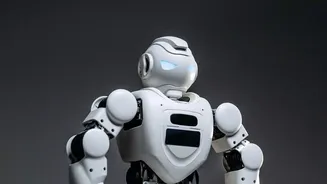
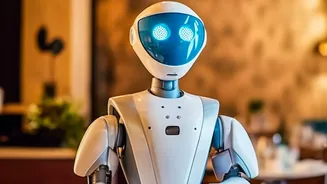
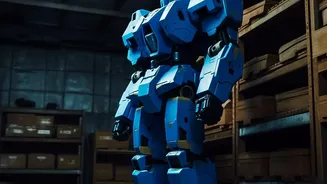
The idea of humanoid robots on a factory floor sounds like science fiction, but for automotive giants and logistics firms, it's a present-day experiment. As companies explore this next frontier of automation, the robots face a daunting test.
The New Mechanical Colleagues
A new class
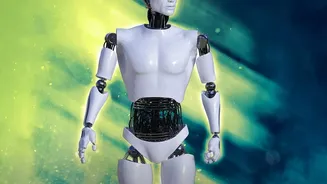
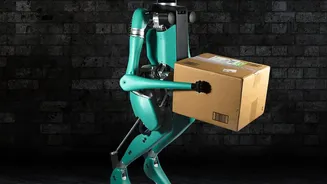
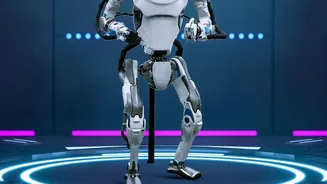
of worker is clocking in at major industrial facilities, but they don't take breaks or collect a salary. Humanoid robots, designed to replicate the form and function of a person, are moving from the lab to the production line. Automakers like BMW and Mercedes-Benz are leading the charge, partnering with robotics startups to see if these machines can handle real manufacturing jobs. At BMW’s plant in South Carolina, a robot from the company Figure has been tested on tasks like moving metal parts for car bodies. Similarly, Mercedes-Benz is piloting the Apollo robot from Apptronik to deliver assembly kits and components to human workers on the line. The primary allure is a robot that can work in spaces designed for people, theoretically avoiding the need for costly factory redesigns that traditional, stationary robotic arms often require. These pilot programs are designed to answer a crucial question: can a robot that looks and moves like a person actually work like one?
Hype vs. The Factory Floor
While impressive videos of robots folding laundry or handling eggs capture public attention, the reality in an industrial setting is far more challenging. The core test is not whether a robot can perform a task once, but whether it can do so reliably for thousands of hours with minimal intervention. The challenges are immense. One of the biggest hurdles is battery life; most current humanoids can only operate for a few hours before needing a lengthy recharge, a far cry from an eight-hour shift. Dexterity is another major issue. Human hands are marvels of engineering, and replicating their ability to handle objects of varying shapes, textures, and fragility is a massive technical challenge. Early factory trials have shown that while robots can perform specific, repetitive tasks, they are often slower than their human counterparts and struggle with unexpected variations.
The Billion-Dollar Question of Cost
For any business, the decision to automate comes down to economics. Currently, advanced humanoid robots can be prohibitively expensive, with some models costing well over $100,000 per unit. However, prices are falling rapidly due to advances in hardware and competition, particularly from Chinese manufacturers. Some analysts project that the price of a capable industrial humanoid could fall to between $20,000 and $30,000 in the coming years. At that price point, the business case becomes much stronger. A robot that can work around the clock doesn't require health benefits, paid time off, or a pension. Proponents argue that once the upfront cost is paid, the operational cost per hour could be significantly lower than human labour. Yet, this calculation doesn't include the significant costs of implementation, maintenance, software, and the human teams required to supervise and service the robots.
Safety and the Future of Work
Perhaps the most critical test is safety. Unlike traditional industrial robots that are often kept in cages, humanoids are designed to work alongside people. A 160nd pound machine moving autonomously through a busy factory creates new and complex safety risks that the industry is still learning to manage. Regulatory bodies are playing catchup, and clear standards for collaborative humanoid robots are still being developed. This raises questions about liability and workplace readiness. For now, the dream of a fully automated factory run by humanoid robots remains on the horizon. The current deployments are more about data collection and learning than replacing human workers at scale. For a country like India, with its vast manufacturing sector, these global developments are a crucial trend to watch. While mass adoption is still years away, these early trials are laying the groundwork for a future where human and humanoid workers may one day share the factory floor.