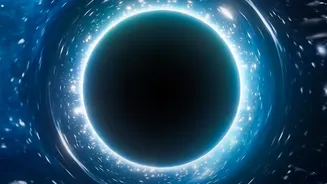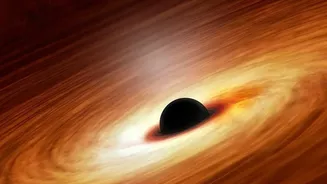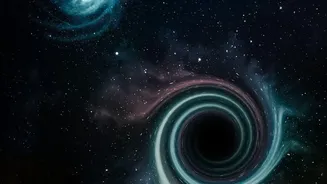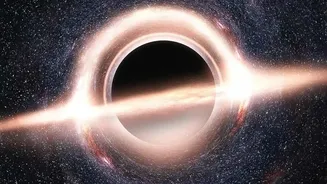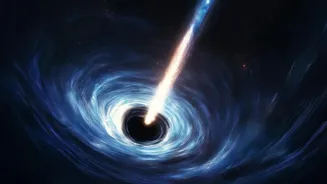





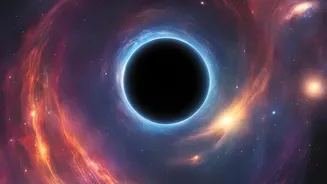

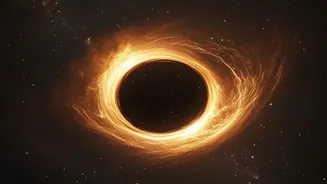
We know black holes can merge, creating gravitational waves that ripple across the cosmos. But can the reverse happen? A new theoretical study explores the bizarre possibility of a single black hole splitting, though it remains firmly on the blackboard.
The Cosmic Rules of Engagement
Black holes are regions of spacetime where gravity is so intense that nothing, not even light, can escape. For decades, our understanding, based largely on Einstein's theory of general relativity, has painted a clear picture: black holes grow, they merge, but they do not divide. This isn't just an arbitrary rule; it's rooted in fundamental physics, particularly thermodynamics. A key concept is entropy, a measure of disorder. The second law of thermodynamics states that the total entropy of an isolated system can only increase or stay the same. For a non-rotating black hole, splitting into two smaller pieces would result in a decrease in total entropy, making the process thermodynamically forbidden. This principle has long served as a cosmic stop sign, preventing physicists from seriously considering black hole division.
A Loophole in Spacetime
A recent theoretical study published in the journal Physical Review D has identified a potential, albeit extreme, loophole. The research, conducted by an international team of physicists, suggests that the thermodynamic barrier might be overcome if a black hole is spinning at an exceptionally high rate. Rotation changes the relationship between a black hole's mass, its spin, and its entropy. The scientists calculated that for a black hole spinning at or very near its maximum possible speed, a split could become thermodynamically favorable. Even then, another major hurdle exists: the two newly formed black holes would have to separate fast enough to avoid their immense gravitational pulls from immediately causing them to collapse back into each other. This requirement narrows the window of possibility even further, restricting it to only the most extreme cases of rotation.
Enter the 'Pair-of-Pants' Topology
To visualize such a mind-bending event, the researchers use a concept called 'pair-of-pants topology'. If a split were to occur, the black hole's event horizon—its point of no return—would contort over time into a shape resembling a pair of trousers. The single 'waistband' of the original black hole would evolve into two distinct 'legs', each representing the event horizon of a new, smaller black hole. This fascinating visual helps conceptualize a change in spacetime topology, which is generally forbidden under classical general relativity. The study suggests that such a split might be more likely if one of the resulting black holes is much smaller than the other, and the phenomenon may be more prone to happen with smaller, primordial black holes that are theorized to have formed in the early universe.
Why It's Still Purely Theoretical
It is crucial to understand that these findings do not mean we will be observing black holes splitting apart anytime soon. The research is entirely theoretical, exploring the absolute limits of what physics might permit. As co-author Francesco Sannino states, scientists cannot yet assign a probability to such an event. The likelihood depends on aspects of gravity that go beyond Einstein's well-tested theory, venturing into the uncharted territory of quantum gravity. For now, the conditions required—specifically, a black hole spinning at its absolute maximum speed—are so extreme that it's unclear if they can even be achieved in nature. The study serves not as a prediction of an observable event, but as a thought experiment that pushes the boundaries of our fundamental understanding of gravity and the cosmos.