



The Sun's Furious Outbursts
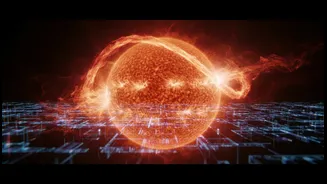
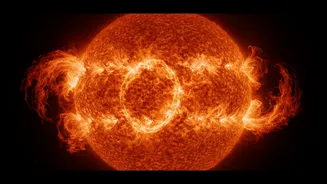
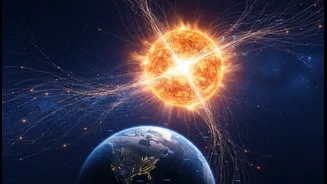
Our Sun is not always the calm, steady source of light and warmth we perceive it to be. It is a dynamic star with an 11-year cycle of activity. During its active periods, it can unleash tremendous explosions of energy called solar flares. These are giant
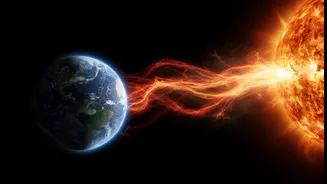
bursts of radiation that happen when magnetic fields on the Sun's surface become tangled and suddenly snap. Often accompanying these flares are coronal mass ejections (CMEs), which are massive clouds of magnetised plasma and charged particles hurled into space at incredible speeds. While a flare's radiation travels at the speed of light, reaching Earth in about eight minutes, the particles from a CME typically take one to three days to make the 150-million-kilometre journey. It is this combination of intense radiation and energetic particles that poses a significant threat to our planet.
How a Solar Storm Disrupts Our World
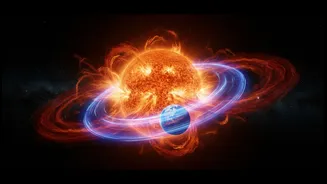
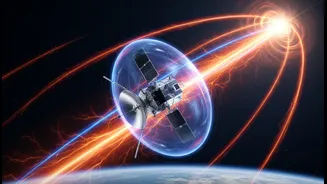
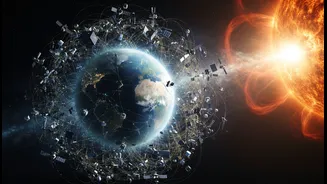
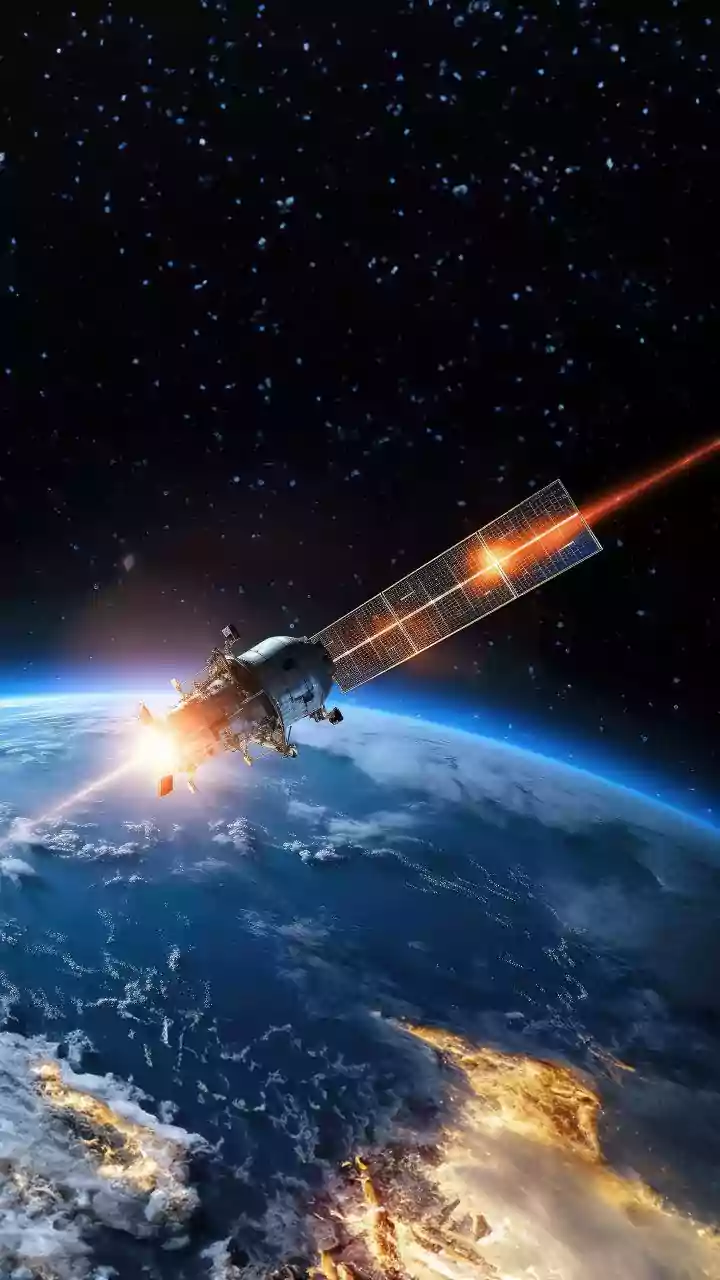
When a powerful, Earth-directed CME arrives, it collides with our planet's protective magnetic field, the magnetosphere. This interaction can trigger a geomagnetic storm. Such a storm has two primary effects. First, high-energy particles can damage the electronics of satellites orbiting outside the protection of our atmosphere. This can lead to malfunctioning GPS navigation, disrupted television broadcasts, and broken communication channels. Second, the fluctuating magnetic field induces powerful electrical currents in long conductors on the ground. These geomagnetically induced currents (GICs) can flow into high-voltage power lines, overwhelming transformers and potentially causing them to overheat, melt, or fail entirely, leading to widespread blackouts. Essentially, the very infrastructure that powers modern life is vulnerable to this invisible threat from space.
A Warning from History: The Carrington Event
The potential for devastation is not just theoretical. In 1859, the most intense geomagnetic storm in recorded history, known as the Carrington Event, struck Earth. Observed by British astronomer Richard Carrington, the associated solar flare was so powerful that telegraph systems worldwide failed. Operators reported receiving electric shocks, and sparks from the equipment even set paper on fire. Auroras, normally confined to polar regions, were seen as far south as Cuba. In 1859, the world's technological dependence was limited to the telegraph. A storm of similar magnitude today could have catastrophic consequences, potentially crippling power grids, satellite networks, and communication systems for weeks or months, with economic damages estimated in the trillions of dollars.
The Power of an Early Warning
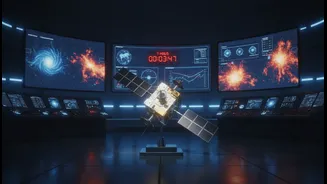
We cannot stop solar storms, but we can mitigate their impact with advance notice. Early detection is key. With a warning, even one of hours or minutes, power grid operators can take protective measures like redirecting power loads or temporarily taking sensitive transformers offline to prevent catastrophic failure. Satellite operators can put their spacecraft into a protective 'safe mode' to shield delicate electronics. Airlines can reroute flights away from polar regions, where the effects of solar radiation are strongest, protecting communication systems and minimising radiation exposure for passengers and crew. A new AI-powered model called DAGGER can already predict a storm's impact with 30 minutes of warning, and future systems aim to extend this window significantly.
India's Eye on the Sun: Aditya-L1
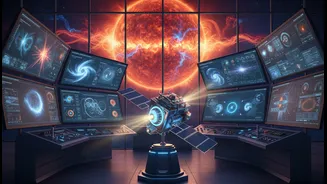
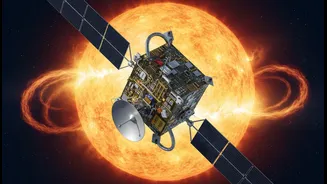
India is a key player in the global effort to monitor the Sun. The Indian Space Research Organisation's (ISRO) Aditya-L1 mission is the nation's first dedicated space-based solar observatory. Positioned at Lagrange Point 1 (L1), about 1.5 million kilometres from Earth, it has an uninterrupted view of the Sun. Aditya-L1's suite of seven instruments observes the Sun's atmosphere and monitors solar flares and CMEs across various wavelengths. The mission has already achieved remarkable success, capturing unprecedented images of a solar flare's 'kernel' and providing crucial data to understand the physics of these massive explosions. This research is vital for improving space weather forecasts and providing more accurate and timely warnings.