



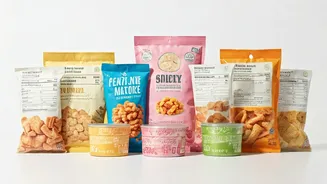




The Marketing Magic on the Front
Food packaging is prime real estate for marketers. Catchy phrases and vibrant images are used to imply health benefits that might not be fully accurate. In recent months, India's food regulator, the FSSAI, has issued notices to numerous companies for making
misleading claims that lack scientific backing. For instance, a product might be labelled “healthy” despite containing a variety of other, less-than-healthy ingredients, or a trade name like “Healthy & Tasty” can itself be deemed misleading. Claims like “100% natural,” “rich in vitamins,” and “heart healthy” can make products seem healthier than they actually are, influencing consumer choices based on an incomplete picture. The truth is, terms like “natural” are not tightly regulated, and a single highlighted benefit can distract from high levels of sugar, sodium, or unhealthy fats.
The Serving Size Trap
Before you even look at calories or sugar, find the serving size. This is one of the most common traps for consumers. The nutritional information provided—calories, fat, sugar—is based on a single serving, but a package often contains multiple servings. A small bag of chips might list 150 calories per serving, but if the pack contains three servings and you eat it all, you've actually consumed 450 calories. Similarly, a bottle of juice might show 10 grams of sugar per serving, but if the serving size is only half the bottle, you could be drinking double that amount without realizing it. Always check the serving size and the number of servings per container to understand the true nutritional impact of what you're consuming.
Decoding the Nutrition Facts Panel
The nutrition panel is your best friend for making informed choices. It provides a standardized breakdown of key nutrients. Here’s what to focus on: Calories give you a measure of energy, but pay attention to where they come from. Look closely at nutrients you should limit, such as saturated fat, sodium, and especially 'Added Sugars'. Many products use multiple types of sweeteners like corn syrup or fruit juice concentrate, so checking the 'Added Sugars' line gives you the full picture. For a quick guide, use the Percent Daily Value (%DV). A DV of 5% or less for a nutrient is low, while 20% or more is high. Aim for low percentages in saturated fat and sodium, and higher percentages for beneficial nutrients like dietary fibre, vitamins, and minerals.
The Ingredient List Reveals All
If the nutrition panel is the 'what', the ingredient list is the 'how'. Ingredients are listed in descending order by weight, so the first few items make up the majority of the product. If you're buying 'multigrain' bread, the first ingredient should be a whole grain, not refined wheat flour (maida). Be wary if sugar or one of its many aliases (high-fructose corn syrup, invert syrup, glucose) appears among the first three ingredients. Also, scan for 'partially hydrogenated oils,' which are a source of trans fats, even if the panel claims 0g trans fat. A short ingredient list with recognizable, whole-food items is generally a better sign than a long list of chemicals and additives.
FSSAI and the Push for Clarity
Recognizing the confusion caused by misleading labels, there is a growing push for greater transparency in India. The Food Safety and Standards Authority of India (FSSAI) is responsible for regulating food labels to ensure they are not deceptive. The authority has recently taken action against brands for everything from unsubstantiated 'healthy' claims on snacks to 'plant-based' labels used without proper approval. There has also been a long-standing discussion, now involving the Supreme Court, about implementing a mandatory Front-of-Pack Labelling (FoPL) system. This system might use a star rating or traffic light signals to give consumers an at-a-glance summary of whether a product is high in sugar, salt, or fat, making it easier to make healthier choices without having to be an expert food detective.