



The Cosmic Data Deluge
For decades, NASA has been our eyes and ears in the universe, with missions like the Hubble, Kepler, and James Webb Space Telescopes sending back breathtaking images and invaluable data. But this success has created a formidable challenge: a data deluge.
The agency now holds more than 150 petabytes of information from its many missions. To put that in perspective, one petabyte is equivalent to about 20 million four-drawer filing cabinets filled with text. Sifting through this mountain of information with traditional methods would take scientists lifetimes, meaning potential discoveries could remain buried in archives for years, or be missed entirely. This data bottleneck is where the real problem lies—not in collecting information, but in processing it efficiently.
AI as a Cosmic Detective
Artificial intelligence, specifically machine learning, is emerging as the perfect partner for space exploration. These AI models can be trained to act as highly efficient cosmic detectives. Scientists can teach an AI what to look for, such as the faint, periodic dip in a star’s brightness that indicates a planet passing in front of it—an event called a transit. The AI then sifts through millions of light curves from telescopes, spotting these subtle patterns far faster and sometimes more accurately than a human analyst could. One such program, called ExoMiner, successfully identified 301 new exoplanets from a trove of old data from the Kepler mission, validating discoveries that had previously been overlooked. This demonstrates AI's power not just to speed things up, but to find needles in a haystack that were previously invisible.
Hunting for New Worlds and Solar Storms
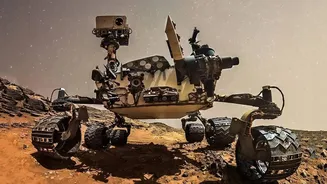
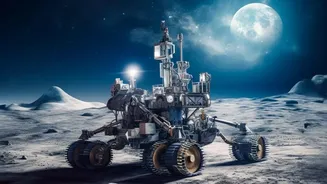
The applications extend far beyond finding distant planets. On Mars, the Perseverance rover uses AI to navigate the treacherous terrain autonomously, selecting its own path and identifying scientifically interesting rock targets for analysis without real-time human command. Back on Earth, AI is being used to protect our technology. A model named Surya, developed by NASA and IBM, analyses imagery from the Solar Dynamics Observatory to predict potentially damaging solar flares with greater advance warning than previous methods. These predictions are crucial for protecting satellites, power grids, and GPS systems from disruptive space weather. By automating pattern recognition, AI frees up human scientists to focus on interpretation, hypothesis, and the bigger questions.
The Dawn of Autonomous Science
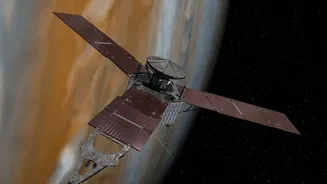
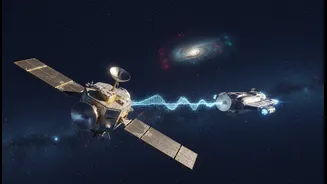
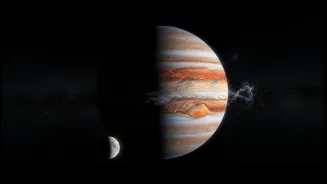
The next frontier is even more ambitious: fully autonomous science. NASA is developing new, radiation-hardened computer chips that are hundreds of times more powerful than current spaceflight processors. These chips will allow spacecraft on deep-space missions to make their own decisions in real-time. Imagine a probe orbiting Jupiter's moon Europa. Instead of waiting for commands from Earth, it could use onboard AI to identify a plume of water vapour erupting from the surface and immediately decide to fly through it to collect samples, a fleeting opportunity that might otherwise be missed. This concept, known as Dynamic Targeting, has already been tested on an Earth-observing satellite, which used AI to identify targets and adjust its instruments in under 90 seconds. This capability will dramatically accelerate the pace of discovery on missions far from home.
A National Mission for Discovery
Recognising this potential, NASA has joined a national initiative called the Genesis Mission, a government-wide effort to leverage AI for accelerating scientific breakthroughs. The mission aims to combine NASA’s vast data archives with powerful AI tools from other agencies, creating a new ecosystem for discovery. The goal is to reduce analysis timelines from years to days, fostering innovation across everything from astrophysics to Earth science. By creating these powerful, open-source tools, NASA is not just advancing its own missions but also empowering the global scientific community to participate in the exploration of our universe.