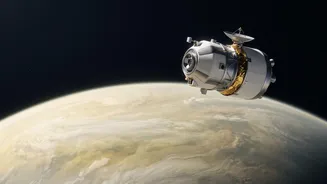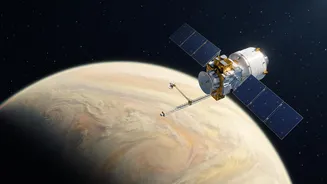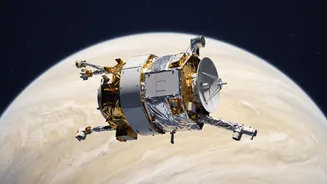





Why Venus? Earth's 'Evil Twin'
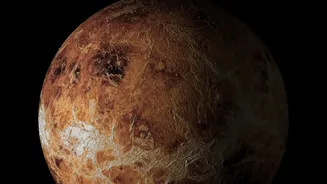
Venus is often called Earth's twin because the two planets are similar in size, mass, and density. But the similarities stop there. Venus is the hottest planet in our solar system, with a surface temperature that can melt lead and an atmospheric pressure
over 90 times that of Earth's. Its skies are permanently covered by a thick blanket of sulfuric acid clouds that race around the planet in a phenomenon known as 'super-rotation'. Understanding why Venus turned into this inferno while Earth remained habitable is a key scientific question. Studying Venus provides a natural laboratory for understanding greenhouse effects, serving as a cautionary tale for climate change on our own planet.
Piercing the Veil: The Radar Advantage
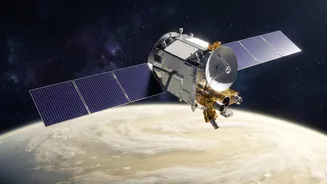
The most significant challenge in studying Venus is its impenetrable cloud cover. To overcome this, Shukrayaan's flagship instrument will be a high-resolution Synthetic Aperture Radar (SAR). Unlike optical cameras that need light, radar actively sends out radio waves that can pierce through the thick clouds and darkness to map the surface below. This technology will allow ISRO to study Venus's geology, look for signs of active volcanoes, and create detailed topographical maps. The mission also plans to carry a ground-penetrating radar, a world-first for Venus, which will study the planet's shallow subsurface, offering clues about its geological history and structure.
Decoding the Atmosphere: A Suite of Sensors
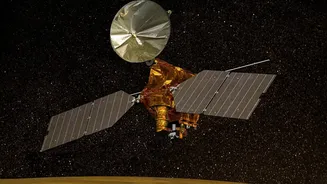
While the radar maps the surface, a dedicated suite of instruments will focus on the main event: the atmosphere. One of the key payloads is VIRAL (Venus InfraRed Atmospheric Gases Linker), a collaborative instrument with France and Russia. This sensor will analyze the chemical composition of the atmosphere, looking for specific gases. Other instruments like a thermal camera and cloud monitoring camera will study the structure, dynamics, and temperature of the cloud layers. These sensors will work together to understand the powerful winds, the composition of the acid clouds, and even search for phenomena like lightning.
The Search for Answers (and Maybe More)
The data from these atmospheric sensors aims to answer fundamental questions. Scientists want to understand the chemistry driving the 20-kilometer-deep sulfuric acid cloud layers. They also want to understand the mechanics of the atmospheric super-rotation, where winds move much faster than the planet's slow rotation. The mission will also investigate how the solar wind, a stream of charged particles from the Sun, interacts with the Venusian ionosphere, which could explain how the planet lost any water it might have once had. In recent years, the controversial detection of phosphine gas in Venus's clouds has raised questions about potential biological processes. While not a primary goal, Shukrayaan's detailed atmospheric analysis could provide crucial data in this ongoing scientific debate.
A Global Collaboration
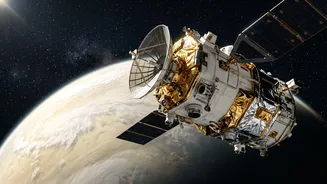
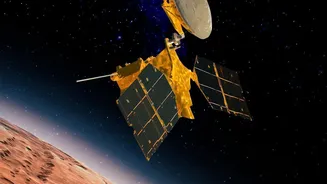
Shukrayaan is a testament to India's growing stature in planetary exploration. The mission, planned for a 2028 launch aboard the powerful LVM-3 rocket, is not a solo effort. It will carry around 19 scientific payloads, including contributions from several international partners. Sweden is providing the Venusian Neutrals Analyser (VNA) to study the interaction between solar particles and the atmosphere. Instruments developed with Russia and France will also be on board, making it a truly global scientific endeavour. This collaboration leverages international expertise while showcasing ISRO's capability to lead complex interplanetary missions.