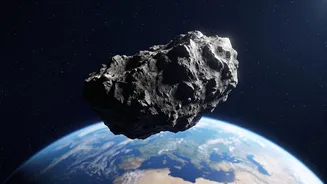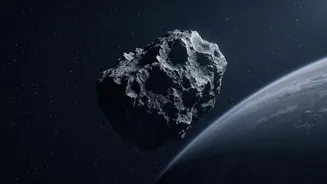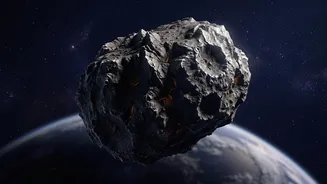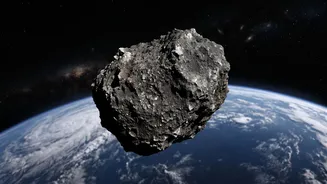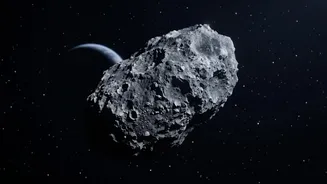



In the vastness of space, some of the most compelling mysteries come in the smallest packages. Meet 1998 KY26, a tiny near-Earth object that has scientists scratching their heads and challenging long-held assumptions about asteroids and comets.
A Small Object with Big Questions
First discovered
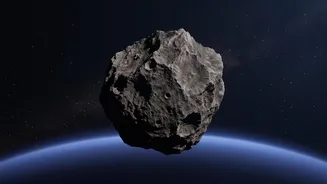
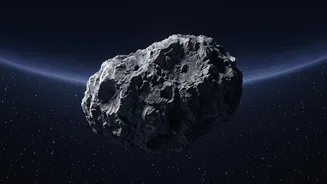
in 1998, 1998 KY26 is a minuscule object, estimated to be only about 11 metres in diameter—roughly the size of a small bus. What it lacks in size, it makes up for in speed, spinning on its axis once every 5.35 minutes. This makes it one of the fastest-rotating objects ever observed in our solar system. Its orbit brings it relatively close to Earth, classifying it as a Near-Earth Asteroid, but its unusual characteristics have made it a subject of intense scientific curiosity and debate. Recent observations have revealed it is surprisingly bright, which adds another layer to the puzzle of its composition and origin. This combination of small size, rapid rotation, and high reflectivity makes it unlike most other asteroids scientists have studied up close.
The Intriguing 'Dark Comet' Theory
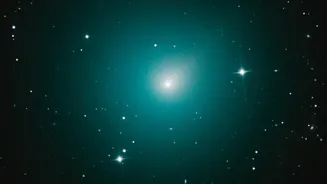
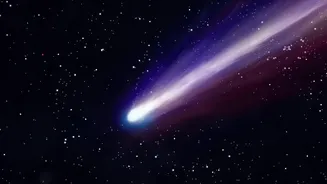
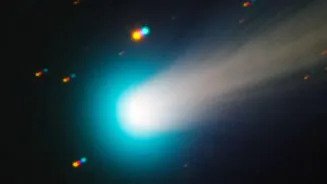
One of the most exciting theories proposed to explain some of 1998 KY26's orbital oddities is that it might be a 'dark comet'. A dark, or extinct, comet is a celestial body that has exhausted most of its volatile ices, like water, after many trips around the sun. It no longer produces a visible coma or tail, making it look like an ordinary asteroid. However, it might still release faint, invisible jets of gas. This outgassing could act like a tiny, natural thruster, causing the object to accelerate in ways that gravity and solar radiation alone cannot explain—a phenomenon observed with 1998 KY26. This possibility placed the asteroid at the centre of a discussion about the blurry line between asteroids and the remnants of ancient comets.
New Research Casts Doubt
The dark comet hypothesis is compelling, but recent research has poured cold water on the idea. A 2026 study from aerospace engineers at the Georgia Institute of Technology suggests that 1998 KY26 is simply too warm to retain the buried ice needed for outgassing. Their thermal models, published in the journal Icarus, indicate that even in its coldest regions, the asteroid's average temperature is well above the point where water ice would sublimate and disappear into space. The researchers calculated that any significant amount of water ice would have vanished in just a couple of thousand years, making the outgassing theory an unlikely explanation for its current behaviour. Other analyses from 2025 also found no evidence of ejected dust and suggested its acceleration could be explained by the Yarkovsky effect, where an object's orbit is altered by the way it absorbs and re-radiates solar energy.
A Future Rendezvous to Solve the Mystery
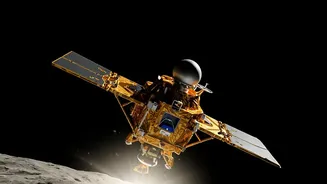
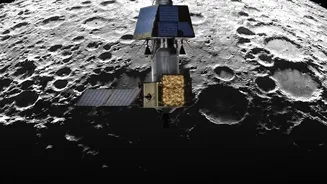
So, what is 1998 KY26? A solid chunk of rock? A rubble pile held together by weak forces? Or something else entirely? A fringe theory even proposes it could be the lost Soviet spacecraft Phobos 1, launched in 1988. The only way to know for sure is to see it up close. Fortunately, that is exactly what is planned. Japan's Aerospace Exploration Agency (JAXA) has directed its Hayabusa2 spacecraft, fresh off its successful sample-return mission from the asteroid Ryugu, toward a new destination. In July 2031, Hayabusa2 is scheduled to rendezvous with 1998 KY26, making it the first time a space mission will visit such a tiny, fast spinning asteroid. The mission aims to uncover the true nature of these small bodies, which could be the building blocks of larger asteroids.