

A New Toolkit for Alien Hunting
For decades, the search for extraterrestrial intelligence (SETI) was defined by radio telescopes pointed at the sky, listening for intentional messages. While that effort continues, the modern search for life is much broader and more subtle. Scientists
now hunt for 'biosignatures'—any substance, element, or pattern that provides evidence of past or present life. This could be as complex as an organic molecule or as simple as a particular mix of gases in a planet's atmosphere that is unlikely to be produced by geology alone. The new strategy isn't just about finding intelligent aliens, but any life at all, from microbes to moss.
Sniffing Distant Atmospheres
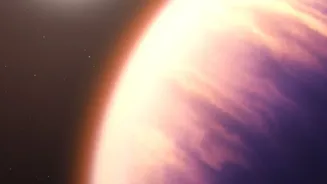
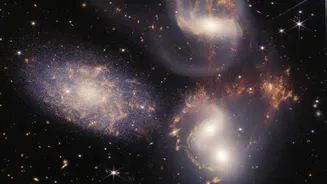
The most powerful new tool in this search is the James Webb Space Telescope (JWST). Launched in 2021, its primary mission includes studying the atmospheres of exoplanets— даже planets orbiting other stars. By analyzing the light that passes through a planet's air, JWST can detect the chemical fingerprints of gases like oxygen, methane, and carbon dioxide. While these gases can exist without life, a specific combination of them could be a strong indicator of biological processes. Recent discoveries have already shown JWST's power, finding an atmosphere on a scorching 'lava world' and providing insights into the violent planetary collisions that shape young solar systems. These observations help scientists understand what makes a planet habitable and refine the list of promising targets for a deeper look.
Searching Our Own Backyard
The hunt for life isn't confined to distant star systems. Some of the most exciting work is happening right here in our solar system. On Mars, NASA's Perseverance rover is exploring the Jezero Crater, the site of an ancient lakebed. In recent years, the rover has detected complex organic carbon molecules in mudstones, the kind of material that could preserve signs of ancient microbial life. While these molecules aren't definitive proof—they can be formed by non-biological processes—their presence in an area that once held water makes it a prime location for investigation. The rover has collected more than 20 rock samples that are planned for a future mission to return them to Earth for in-depth analysis.
The Promise of Icy Moons
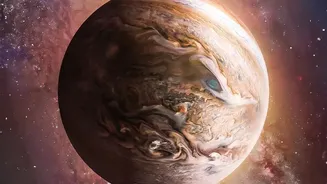
Beyond Mars, scientists are looking toward the icy moons of Jupiter and Saturn. Jupiter's moon Europa is considered one of the most promising candidates for harbouring life in our solar system because it shows strong evidence of a vast liquid water ocean beneath its icy shell. NASA's Europa Clipper mission, launched in October 2024, is currently en route to Jupiter and is scheduled for an Earth gravity assist in December 2026. It will arrive in 2030 and perform dozens of close flybys of Europa, using ice-penetrating radar and spectrometers to analyze its surface, assess the ocean's potential habitability, and even scout for plumes of water erupting into space. Similar interest surrounds Saturn's moon Enceladus, which is also known to have a subsurface ocean.
The Next Generation of Eyes on the Sky
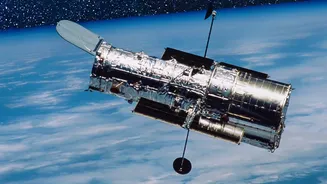
The search is only set to accelerate. The Nancy Grace Roman Space Telescope, launched in August 2026, will survey huge swathes of the sky, with a field of view 100 times larger than Hubble's. It is designed to find thousands of new exoplanets, providing a massive new catalogue for JWST to investigate. Further on the horizon is the Habitable Worlds Observatory (HWO), a mission concept for the 2040s designed specifically to directly image Earth-like planets and analyze their atmospheres for biosignatures. The technology is being designed to be serviceable by robots, allowing for upgrades and repairs to extend its mission for decades. These future observatories represent a generational leap in our ability to finally answer whether other living worlds exist.