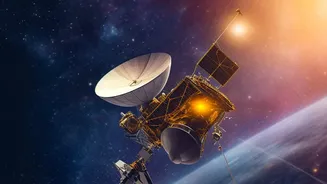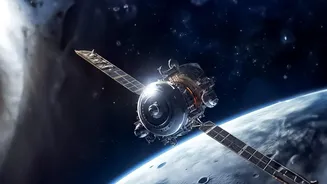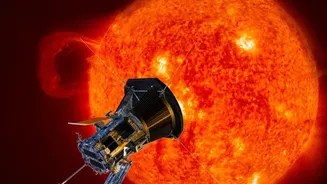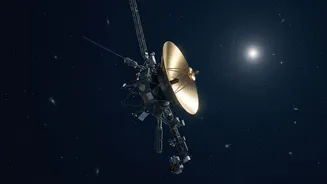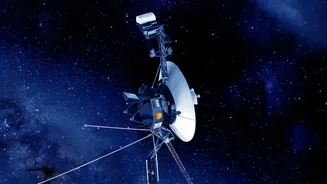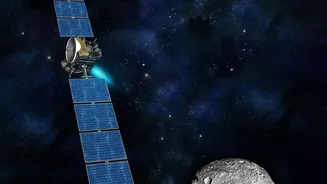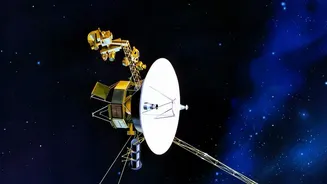

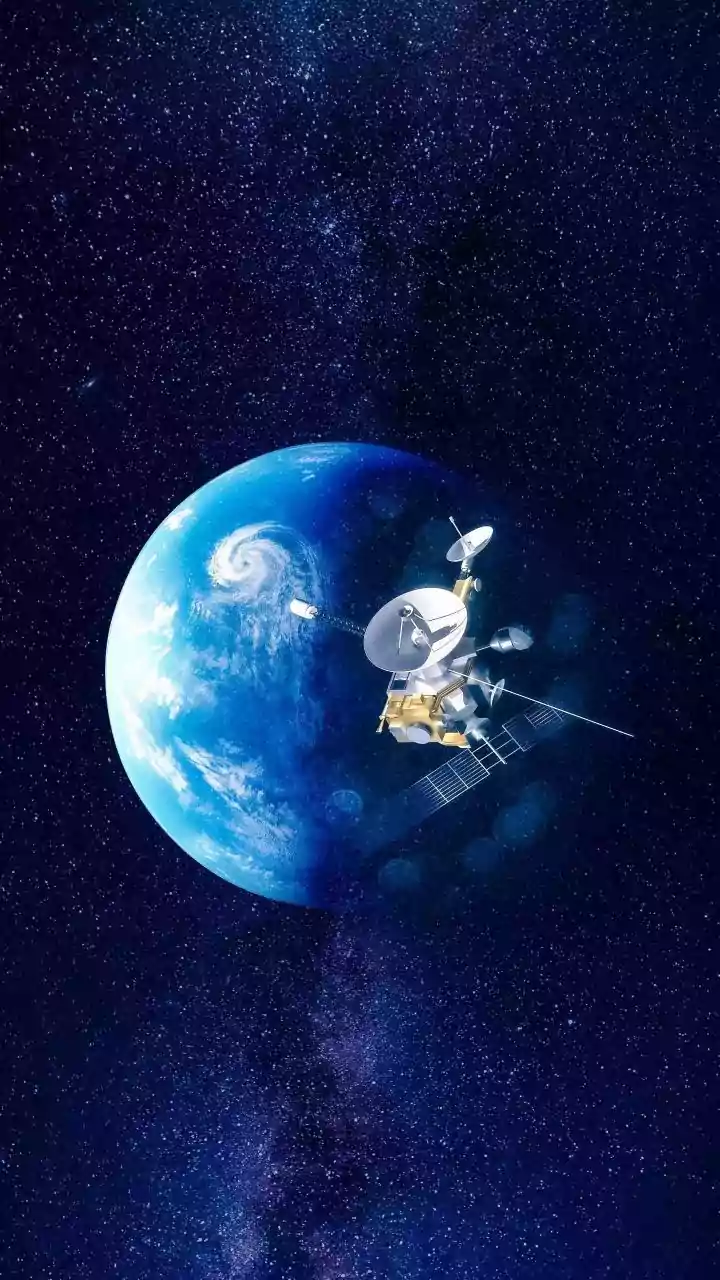
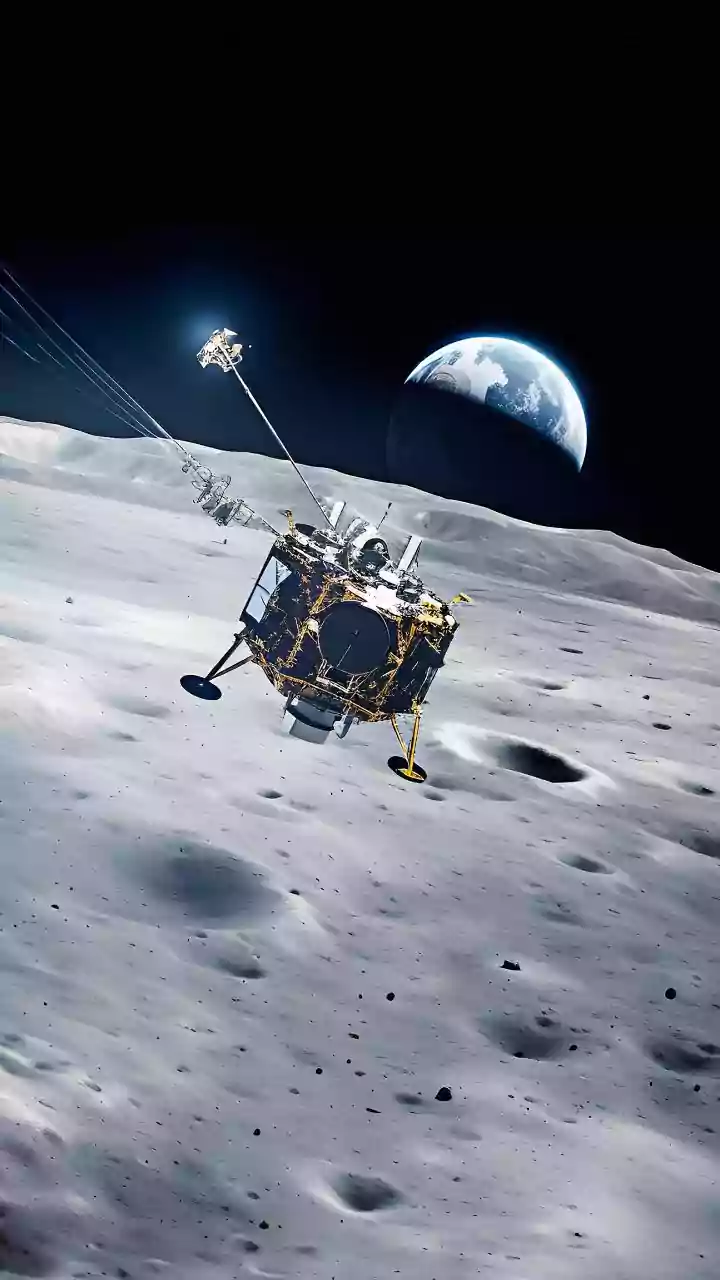
Nearly 50 years after leaving Earth, a piece of 1970s technology is about to hit a truly astronomical milestone. NASA’s Voyager 1, humanity’s most distant creation, will soon be a full light-day away from its home planet.
A Journey Beyond Imagination
Mark your calendars for November
18, 2026. On that day, the Voyager 1 spacecraft will achieve something unprecedented: it will be one light-day away from Earth. Launched on September 5, 1977, the probe has been travelling for nearly five decades, pushing the boundaries of exploration. Having long ago completed its primary mission of studying Jupiter and Saturn, it has since become an interstellar scout, famously crossing the heliopause in 2012 to become the first human-made object to enter the space between stars. This new milestone is a testament to the incredible engineering and longevity of a mission that continues to send back data from the void.
What is a Light-Day?
It is a distance so vast it’s difficult to comprehend. A light-day is the distance a beam of light travels in 24 hours. Given that light moves at approximately 299,792 kilometres per second, that works out to about 25.9 billion kilometres. To put that in perspective, light from the Sun takes just over eight minutes to reach Earth. A radio signal sent from NASA’s Deep Space Network to Voyager 1 on November 18 will take a full 24 hours to arrive. Any response from the probe will take another 24 hours to travel back. This 48-hour round trip time highlights the immense scale of Voyager's journey.
The Grand Tour's Enduring Legacy
The Voyager mission was born from a rare planetary alignment in the 1970s that allowed a spacecraft to use gravity assists to visit the outer planets. Voyager 1’s primary mission was to perform flybys of Jupiter and Saturn. In 1979, it revealed the first active volcanoes beyond Earth on Jupiter’s moon Io and discovered Jupiter’s faint ring system. In 1980, it studied Saturn’s complex rings in detail and explored its giant moon, Titan. Having completed these goals, its trajectory sent it hurtling out of the plane of the solar system and towards the stars. Its twin, Voyager 2, took a different path to visit Uranus and Neptune.
Still Talking Across The Void
Communicating with a half-century-old probe billions of kilometres away is a monumental challenge. Voyager 1 sends signals back to Earth using a transmitter that, by modern standards, is incredibly weak, and its data transmission rate is a mere 160 bits per second. The probe is powered by radioisotope thermoelectric generators, which convert heat from decaying plutonium into electricity. That power supply is dwindling, losing about four watts per year. NASA engineers have become experts at managing the spacecraft's limited resources, recently overcoming a major memory chip failure that garbled its data for months. These efforts are expected to keep at least one scientific instrument running into the 2030s.
Humanity's Farthest Emissary
Voyager 1 is more than just a piece of hardware; it’s a cultural icon. It carries the 'Golden Record', a gold plated copper disc containing sounds and images selected to portray the diversity of life and culture on Earth. Conceived by a committee led by the late Carl Sagan, it includes greetings in $55$ languages, music from Bach to Chuck Berry, and $115$ images. It’s a message in a bottle thrown into the cosmic ocean, a symbol of our hope and curiosity. While the chances of it being found are infinitesimally small, the act of sending it speaks volumes about the human spirit. In about $40$,$000$ years, the silent probe will pass near a star called Gliese $445$.