





The Cosmic Detective Tool
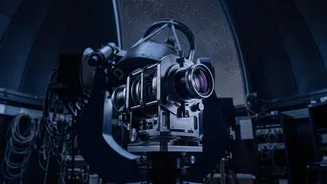
At the heart of this long-distance detective work is an instrument called a spectrograph. Think of it as a high-tech prism. While a simple prism splits white light into the familiar colours of the rainbow, a spectrograph does this with incredible precision,
spreading light from a star or planet into a broad spectrum. This allows astronomers to see the light in far more detail than the human eye can, including in infrared and ultraviolet wavelengths. This detailed 'rainbow' is the key to unlocking the chemical secrets of a planet's atmosphere. Telescopes like the James Webb Space Telescope (JWST) are equipped with highly advanced spectrographs specifically designed for this purpose.
Reading a Planet's Barcode
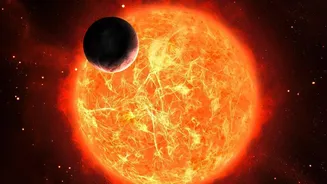
The main technique used is called transmission spectroscopy. It works when an exoplanet passes in front of its host star from our point of view, an event called a 'transit'. During a transit, a tiny fraction of the star's light filters through the planet's atmosphere before it reaches our telescopes. As the light passes through, gases in the atmosphere absorb very specific colours, or wavelengths, of that light. Every chemical element and compound—like water, methane, or carbon dioxide—has a unique absorption pattern, like a barcode. When scientists look at the star's spectrum after it has passed through the atmosphere, they see this barcode as a series of dark lines or 'dips' where light is missing.
Decoding the Spectral Lines
These missing lines in the spectrum are the clues. Scientists compare the spectrum of the star when the planet is in front of it to the spectrum of the star by itself. The difference between the two reveals the absorption lines caused by the planet's atmosphere. By matching the pattern of these lines to the known 'fingerprints' of different gases, they can determine the chemical composition of that distant world's air. For instance, if they see dips in the spectrum at the exact wavelengths where water vapour is known to absorb light, they can confidently infer the presence of water in that planet's atmosphere.
The Search for Biosignatures
This technique goes beyond simply listing chemicals; it's a core part of the search for life beyond Earth. Scientists are looking for 'biosignatures'—gases or combinations of gases that are unlikely to exist in large quantities without a biological origin. On Earth, the large amount of oxygen is a primary biosignature, as it's constantly replenished by life through photosynthesis. Finding certain gases together, like methane and oxygen, could be a strong indicator of life, as they would normally react and destroy each other without a constant source. Advanced telescopes like the JWST can detect potential biosignatures like methane, carbon dioxide, and even signs of industrial pollutants, offering a tantalizing glimpse into a planet's potential habitability.
Beyond Transits: Other Methods
While transmission spectroscopy is a powerful tool, it's not the only one. Scientists can also use spectrographs to study the light that is reflected off a planet's surface or atmosphere, a method known as reflectance spectroscopy. Another technique, emission spectroscopy, analyzes the thermal infrared radiation that a planet emits itself. This can provide valuable information about a planet's temperature and climate. By combining data from these different methods, astronomers can build a more complete and detailed picture of an exoplanet, moving from a simple dot of light to a complex world with its own unique chemistry and climate.