





Creating a Personal Atmosphere
The most immediate threat in space is the lack of air. Space is a near-perfect vacuum, meaning there is virtually no pressure. Unprotected, a person would lose consciousness in under 15 seconds as air rushes from the lungs and gases in the blood begin
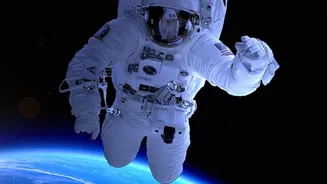
to bubble. A spacesuit, formally known as an Extravehicular Mobility Unit (EMU), counteracts this by creating a pressurized environment. The suit is inflated with pure oxygen to about one-third of Earth's atmospheric pressure. This is enough pressure to keep the body's fluids liquid and provide breathable air, while being low enough to allow the astronaut some flexibility. The suit’s life support system, located in the backpack, not only provides a steady flow of oxygen but also scrubs the exhaled carbon dioxide, which would be toxic if allowed to build up.
A Thermos for the Human Body
Space has no atmosphere to distribute heat, leading to extreme temperature swings. In direct sunlight, a suit's surface can heat up to 121°C, and in shadow, it can plunge to a frigid -157°C. To survive this, a spacesuit is a masterpiece of insulation. The outer layers are white to reflect the harsh sunlight. Beneath this are multiple, alternating layers of Mylar—a reflective material—and synthetic spacer fabric, which work like a high-tech thermos bottle to insulate the astronaut from the external extremes. But insulation isn't enough; astronauts generate their own body heat. To prevent overheating, they wear a Liquid Cooling and Ventilation Garment underneath the main suit. This garment is a full-body mesh suit threaded with about 300 feet of thin tubes that circulate cool water, drawing heat away from the astronaut's body.
An Armour Against Invisible Threats
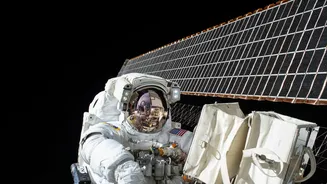
Beyond pressure and temperature, space is filled with invisible dangers. One is radiation from the sun and deep space in the form of galactic cosmic rays. While a spacecraft provides significant shielding, a spacesuit offers limited but crucial protection during a spacewalk, primarily through its multiple layers and a special gold-coated helmet visor that reflects harmful ultraviolet and infrared light. Another constant threat is micrometeoroids. These are tiny particles of rock or metal, often no bigger than a grain of sand, moving at speeds of thousands of kilometres per hour. To protect against these hyper-velocity impacts, the outer layers of a spacesuit are made from incredibly tough, tear-resistant materials like Kevlar and Nomex, designed to break up and stop these particles before they can puncture the inner, pressure-critical layers.
A Mobile Command Centre
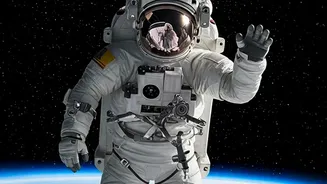
A spacesuit is not just a passive shell; it's an active life support machine. The backpack, known as the Portable Life Support System (PLSS), is the brain and heart of the operation. It contains the oxygen tanks, the system for removing carbon dioxide, lithium-ion batteries for power, a fan for circulating air, and the water tank and pump for the cooling garment. It also houses the suit's two-way radio, providing a vital communications link to the crew inside the spacecraft and Mission Control on Earth. All of this is monitored and can be adjusted by the astronaut via a control module mounted on the suit's chest, allowing them to manage their own personal environment as they work.