


What is a Superhabitable World?
The idea of a superhabitable planet was first formally proposed in 2014 by astrophysicists René Heller and John Armstrong. They argued that our search for alien life was too Earth-centric. Instead of just looking for 'Earth-like' planets, we should identify
worlds with conditions that could support a richer, more abundant, and more diverse biosphere than our own. It's a shift from an Earth-centric view to a 'biocentric' one, which prioritizes the conditions for life itself, not just life as we know it. These theoretical planets wouldn't just be habitable; they would be more habitable than Earth.
A Better Sun
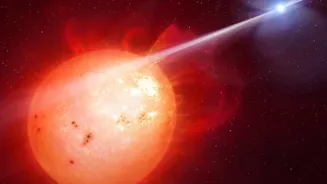
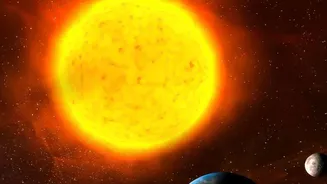
The type of star a planet orbits is crucial. Our Sun is a G-type star, or a yellow dwarf, with a lifespan of about 10 billion years. Life on Earth took nearly 4 billion years to evolve into complex forms. Stars more massive than our Sun burn out too quickly, but stars slightly less massive could be better hosts. K-type stars, often called orange dwarfs, are the sweet spot. They can remain stable for 20 to 70 billion years, giving life a much longer, more stable period to emerge and evolve. They also emit less harmful UV radiation and have lower flare activity than the even smaller and more common M-type red dwarfs, offering a more stable environment for any orbiting planets.
Bigger, Wetter, and Flatter
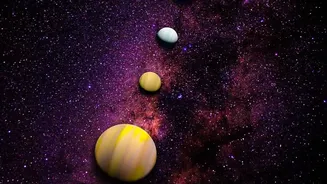
A superhabitable planet would likely be a 'super-Earth'—up to 1.5 times larger and about 10 times more massive than our world. Greater mass means stronger gravity, which is better at holding onto a protective atmosphere. This increased gravity would also flatten the planet’s topography. The result would be a world of sprawling archipelagos and vast, shallow oceans, rather than deep ocean basins like Earth’s. These warm, shallow seas are ideal nurseries for life and could lead to incredible biodiversity, much like Earth’s tropical rainforests and coral reefs. More mass also means a hotter core for longer, driving geological activity like plate tectonics that is crucial for regulating climate and recycling nutrients.
A Milder, More Stable Climate
While Earth's average temperature is about 15°C, a superhabitable world might be slightly warmer, with an average closer to 25°C. This increased warmth, combined with higher humidity and more oxygen, could fuel a larger and more active biosphere. Furthermore, a world with oceans more evenly distributed across its surface would have a more moderate global climate with less extreme temperature swings between regions. These conditions, combined with a slightly older age than Earth's 4.5 billion years, would mean more time for life not just to appear, but to diversify into complex forms.
The Search for Better Earths
This isn't just a thought experiment. Astronomers are actively using these criteria to sift through the thousands of exoplanets we've discovered. In 2020, a study identified 24 potential superhabitable candidates out of more than 4,000 known exoplanets at the time. Planets like KOI 5715.01 fit many of the criteria: orbiting a stable K-type star at the right distance, and estimated to be older and wetter than Earth. While we don't yet have proof of life on these worlds, the concept of superhabitability is reshaping how we search for it. Advanced instruments like the James Webb Space Telescope are now examining the atmospheres of these distant worlds, looking for the chemical signatures that might tell us we're not alone—and that we might not even be living in the best neighbourhood.