


A New Chapter in Cosmic Exploration
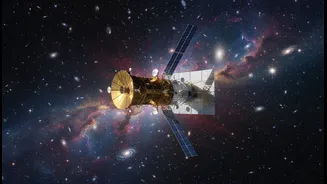
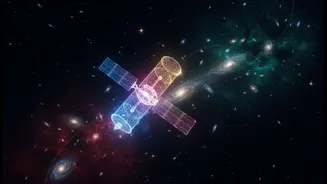
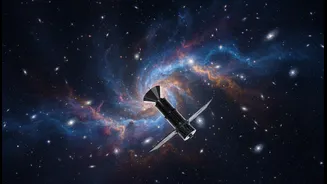
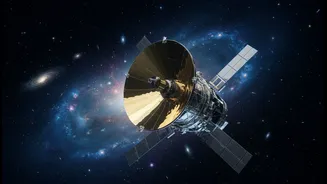
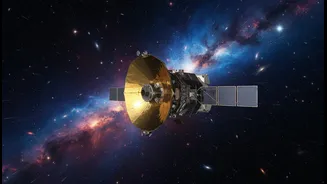
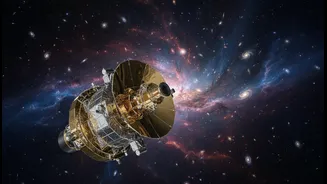
Named after Nancy Grace Roman, NASA's first Chief of Astronomy and the “Mother of Hubble,” this next-generation telescope is the culmination of years of development. Having completed its assembly and testing at Goddard Space Flight Center, the telescope has
already arrived at the Kennedy Space Center in Florida for its final launch preparations. Set to launch aboard a SpaceX Falcon Heavy rocket, Roman will travel to the second Sun-Earth Lagrange point (L2), a stable gravitational point about 1.5 million kilometres from Earth, where it will begin its five-year primary mission. From this vantage point, it will embark on a survey of the heavens unlike any before.
Seeing Wider, Not Just Deeper
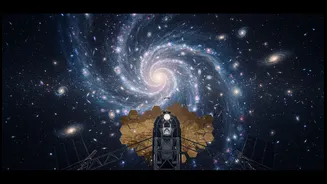
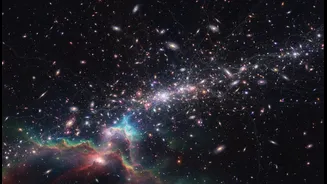
While the Hubble and James Webb Space Telescopes are renowned for their deep, detailed images of small patches of sky, Roman is designed for breadth. Its key feature is a massive field of view. With a 2.4-meter primary mirror—the same size as Hubble's—Roman can capture an area of the sky 100 times larger in a single snapshot. Imagine trying to take a picture of a sprawling city. Hubble and Webb would be like focusing on a single building in exquisite detail, while Roman will capture the entire city skyline with the same sharpness. This wide-angle perspective allows Roman to survey the sky more than 1,000 times faster than Hubble, creating vast cosmic maps that will identify new targets for other telescopes to study in detail.
Tackling the Universe's Biggest Mysteries
Roman has two primary scientific goals that strike at the heart of modern cosmology. The first is to investigate dark energy, the mysterious force believed to be causing the accelerated expansion of the universe. By mapping the distribution of billions of galaxies and observing distant stellar explosions called supernovae, Roman will provide unprecedented data to help scientists understand this enigmatic phenomenon. The second major goal is to conduct a census of exoplanets. Using a technique called gravitational microlensing, Roman will detect the tiny, temporary brightening of distant stars as a planet passes in front of them. This method is sensitive enough to find planets of all sizes, including those smaller than Earth and even 'rogue' planets that drift through space without a host star.
A Flood of Discovery Awaits
The sheer volume of data Roman is expected to generate is staggering. In its primary mission, it could discover as many as 100,000 new exoplanets—more than all other telescopes combined to date. It will also observe millions of galaxies and capture transient events like the shredding of stars by supermassive black holes. This data, amounting to roughly 20,000 terabytes, will be made public for scientists worldwide to analyze. Teams are already preparing for this deluge, developing new software and techniques to comb through the information and unearth the discoveries hidden within. The telescope is not just a tool for its primary missions; it's a versatile observatory that will contribute to nearly every area of astrophysics, from studying small objects in our own solar system to understanding the evolution of the largest structures in the cosmos.