


A Hurdle Cleared for Astronaut Safety
The Indian Space Research Organisation (ISRO) has confirmed the successful completion of several key qualification tests for the Gaganyaan mission's Crew Module. These recent trials, which took place in July and August 2026, focused on some of the most
critical phases of the mission: ensuring the capsule can survive the fiery re-entry into Earth's atmosphere, deploy its parachutes correctly, and safely splash down in the ocean. This isn't just a routine check; it's a fundamental validation of the systems designed to protect the lives of the 'Gaganyatris'—India's astronauts. Successfully testing these components moves the ambitious human spaceflight program significantly closer to its first uncrewed, and eventually crewed, launch.
What is the Capsule Recovery System?
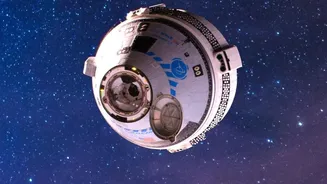
Getting to space is only half the battle; coming home safely is the hardest part. The capsule recovery system is a complex sequence of technologies designed to manage the Crew Module's return. It starts after the capsule separates from its service module high above the Earth. The module then endures a high-speed, high-temperature atmospheric re-entry. To slow its descent, the system relies on a series of parachutes. The sequence involves deploying smaller drogue parachutes to stabilize the capsule, followed by massive main parachutes that slow it to a safe landing speed for a splashdown in the ocean. Recent Integrated Air Drop Tests involved dropping a dummy module from an aircraft to validate this entire parachute sequence from deployment to splashdown. Furthermore, tests also validated the Crew Module Uprighting System (CMUS), which uses inflatable bags to ensure the capsule stays upright after landing in the sea, a critical feature for astronaut recovery.
The Fiery Challenge of Re-entry
Bringing a spacecraft back from orbit is a monumental engineering challenge. As the capsule hits the upper atmosphere at immense speeds, friction generates incredible heat, turning it into a man-made meteor. The capsule's heat shield must withstand temperatures that can melt metal, protecting the astronauts inside. Following this, the parachute system must perform flawlessly. If the chutes deploy too early, they could be shredded; too late, and the capsule will not slow down enough for a safe landing. The system is designed with redundancy, meaning even if one of the three main parachutes fails, the remaining two are sufficient to land the crew safely. The recent tests were designed to prove that every component, from the pyrotechnics that jettison the parachute cover to the structural integrity of the capsule itself, can withstand the violent forces of the return journey.
Gaganyaan's Path Forward
With these critical recovery systems now validated, ISRO is proceeding with the next phases of the Gaganyaan program. The path to the first human flight is methodical and built on caution. The next major steps include a series of uncrewed test flights. The first of these, the G1 mission, is expected to launch in late 2026 or early 2027. This mission will be a full dress rehearsal without astronauts, likely carrying 'Vyommitra', a humanoid robot, to monitor all life support and flight parameters. Following the successful completion of at least two uncrewed missions that demonstrate the reliability of the launch vehicle and capsule, ISRO will proceed with the first crewed mission, designated H1, which is currently anticipated for 2027.
A Leap for India's Space Ambitions
The Gaganyaan mission represents more than just a technological achievement; it's a statement of India's growing capabilities and ambitions in space exploration. Upon successful completion, India will join an exclusive club of nations—the United States, Russia, and China—capable of sending its own astronauts into space. This self-reliance in human spaceflight opens the door to more advanced future endeavours, including potentially establishing an Indian space station and participating in global deep-space exploration missions. Each successful test, like the recent validation of the capsule recovery systems, is not just a technical win but a moment of national pride, showcasing the dedication and expertise of thousands of scientists and engineers across the country.