


The Cosmic Shadow Play
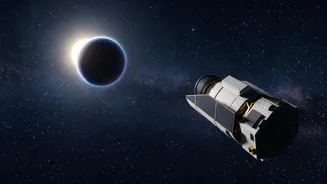
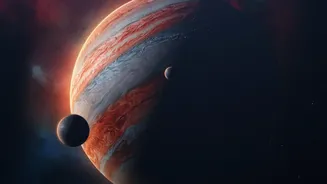
The primary method for sniffing out alien atmospheres is called transit spectroscopy. Imagine watching a bright lightbulb from a distance. If a tiny moth flies in front of it, the light will dim ever so slightly. Astronomers do something similar with
stars and exoplanets. When an exoplanet passes, or 'transits', in front of its host star from our point of view, it blocks a minuscule fraction of the starlight. For this method to work, the planet's orbit must be aligned perfectly with our line of sight, which is a rare but crucial geometric alignment.
Decoding a Starlight 'Barcode'
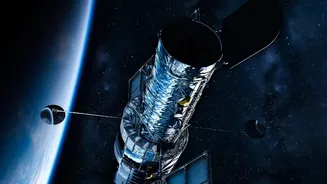
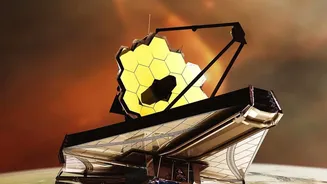
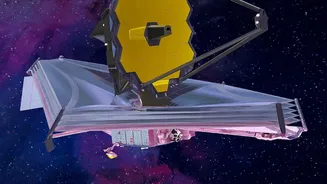
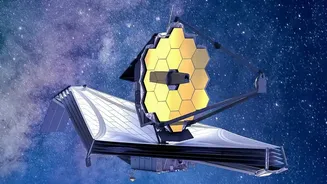
Here's where it gets clever. That tiny sliver of starlight doesn't just get blocked; some of it filters through the very edge of the planet's atmosphere. As the light passes through, gases in the atmosphere absorb very specific colours, or wavelengths, of that light. Each gas—like oxygen, methane, or water vapour—has a unique 'fingerprint' of light that it absorbs. When the light finally reaches a telescope like the James Webb Space Telescope (JWST), it's missing these specific slivers of colour. Scientists can then analyse this altered light, called a transmission spectrum, which acts like a chemical barcode revealing which gases are present in that distant world's air.
The Chemical Shopping List for Life
So, what are scientists looking for in this cosmic barcode? They're hunting for 'biosignatures'—gases that, on Earth, are strongly linked to biological processes. The classic contenders are molecules like oxygen, methane, and carbon dioxide. Finding any one of these isn't proof of life, as they can also be produced by geological activity. The real prize is finding a combination of gases that shouldn't exist together without life constantly replenishing them. For example, finding both oxygen and methane in large quantities is a strong hint, because these two gases would normally react and destroy each other over time. Their continued coexistence suggests something is actively producing both.
Beyond the Usual Suspects
Recent discoveries have expanded this chemical shopping list. One particularly exciting molecule is dimethyl sulfide (DMS). On Earth, DMS is produced almost exclusively by marine life, like phytoplankton. In 2026, observations of the exoplanet K2-18 b by the JWST showed tantalising hints of DMS, alongside methane and carbon dioxide, in the atmosphere of what might be a water-covered 'Hycean' world. While this is not a confirmation of life, it represents one of the most compelling pieces of evidence found to date and directs astronomers where to look next.
The Challenge of False Positives
This work is incredibly challenging. The signals are faint, and the planets are unimaginably far away. Distinguishing the tiny absorption signature of a planet's atmosphere from the overwhelming light of its star is a monumental technical feat. Furthermore, scientists must be careful to rule out all non-biological explanations for the gases they detect. A planet's unique geology or the type of light from its star could create chemical signatures that mimic life. This is why a single detection is never considered definitive proof. The process requires extensive follow-up observations and rigorous modelling to build confidence and rule out false positives.