




What Exactly Is Aphelion?
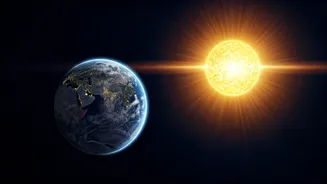
Aphelion is the point in Earth's orbit where it is most distant from the sun. The name comes from Greek words: 'apo' meaning away or apart, and 'helios' for the sun. This event happens every year in early July. It's the opposite of perihelion, which occurs
in early January, when Earth is closest to the sun. The reason for this variation is that Earth’s orbit isn't a perfect circle. It’s a slight ellipse, with the sun not perfectly in the center. On July 6, 2026, Earth will be about 152.1 million kilometers (around 94.5 million miles) from the sun. That’s roughly 5 million kilometers farther than it was during its closest approach in January.
The Real Reason for Seasons
It’s a common and logical misconception to think that our distance from the sun dictates our seasons. If that were true, the entire planet would experience winter in July. The real cause of the seasons is the tilt of Earth’s axis, which is angled at about 23.5 degrees. During the Northern Hemisphere's summer, this part of the Earth is tilted toward the sun. This tilt means the sun's rays hit the northern half of the planet more directly and for longer periods each day, leading to warmer temperatures and the summer season. Conversely, the Southern Hemisphere is tilted away from the sun, receiving less direct sunlight, which results in its winter. The difference in distance at aphelion is not significant enough to override the effect of this axial tilt.
A Slower Journey Through Space
An interesting side effect of aphelion relates to the speed of our planet. According to Kepler's Second Law of Planetary Motion, a planet moves slower when it is farther from the sun and faster when it is closer. This is because the sun's gravitational pull is slightly weaker at a greater distance. As Earth approaches aphelion on July 6, it will be moving at its slowest orbital speed of the year, approximately 29.3 kilometers per second (about 105,480 km/h). For comparison, at its fastest point during perihelion in January, it travels at about 30.3 kilometers per second (about 109,080 km/h). This cosmic slowdown is also why the summer season in the Northern Hemisphere is the longest of the four seasons.
Can You See or Feel the Difference?
In short, no. Aphelion is a significant event on a cosmic scale, but it has no perceptible effect on our daily lives. The roughly 3% variation in distance between aphelion and perihelion doesn't create noticeable changes in our weather or daily temperatures. The change in the sun's apparent size in the sky is also too small to be seen with the naked eye. While technically the sun appears slightly smaller at aphelion, you would need specialized equipment and side-by-side photos to tell the difference. The primary driver of the warmth you feel in July is the direct angle of sunlight and longer days, all thanks to our planet's tilt.