


The Allure of Hidden Oceans
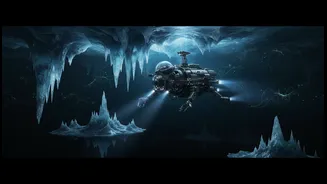
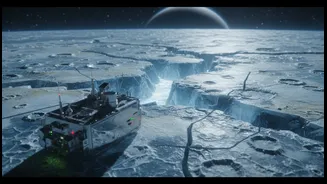
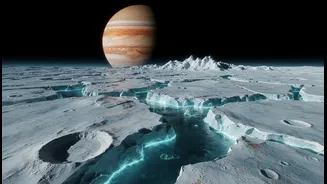
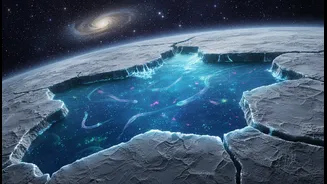
In our solar system, some of the most compelling places to search for life are not planets, but the moons of giants like Jupiter and Saturn. Moons such as Europa and Enceladus are covered in thick shells of ice, but beneath them lie vast liquid water
oceans. These oceans are kept warm by the gravitational push and pull of their host planets, and evidence suggests they contain chemical energy sources and organic building blocks—the essential ingredients for life as we know it. Plumes of water vapour erupting from Enceladus’s surface even offer the tantalizing possibility of sampling this hidden ocean without having to drill through kilometres of ice.
The Danger of a False Positive
For decades, the search for extraterrestrial life has focused on finding 'biosignatures'—a chemical or molecule, like oxygen or methane, that could signal biological activity. The problem is that non-living geological or chemical processes can sometimes mimic these signs, creating a 'false positive'. Finding a single organic molecule, such as an amino acid, isn't enough proof, because these can be created by non-biological chemistry. Declaring the discovery of alien life based on a single, ambiguous piece of evidence carries a huge risk of being wrong. This has led scientists to argue for a much higher standard of proof, one that requires multiple lines of evidence before making any extraordinary claims.
Building a Case with Multiple Tests
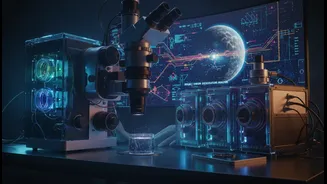
The new strategy in astrobiology is to act less like a prospector looking for a single gold nugget and more like a detective building a case. This means using a suite of instruments to run multiple, independent chemical tests. For example, life on Earth shows distinct preferences. It uses only 'left-handed' amino acids to build proteins and creates lipids (fats) with specific, repeating chain lengths. Finding just one of these patterns could be a coincidence. But finding a specific ratio of amino acids, particular lipid patterns, and unusual concentrations of certain elements all in the same sample would be much harder to explain away through non-living chemistry. Instruments like the Ocean Worlds Life Surveyor (OWLS) are being designed to perform exactly this kind of multi-faceted analysis, looking for several molecular fingerprints at once.
It's All About the Context
Finding a collection of interesting chemicals is still only half the battle. The other crucial half is understanding the 'environmental context'. Scientists must prove that the alien world's own geology and chemistry couldn't have produced the patterns they observe. This requires deeply characterizing the environment: What minerals are in the rock? What chemical reactions are possible in the ocean? For example, if scientists detect a biosignature, they must first rule out that interactions between water and rock, or the breakdown of molecules by radiation, could have created the same signal abiotically (without life). This approach means that future missions won't just be life-detection missions; they will be comprehensive planetary science missions aimed at understanding the world as a complete system.
Raising the Bar for Discovery
This combined approach of using multiple chemical tests while thoroughly understanding the environmental background creates a much stricter, more robust standard for life detection. Scientists sometimes refer to this as a 'Ladder of Life Detection,' where each piece of evidence adds another rung, making the case for life progressively stronger. This careful, methodical process is designed to avoid the critical error of a false positive, but also to guard against 'false negatives'—where we might miss signs of life because our instruments are too limited or our assumptions are too narrow. As we prepare to send advanced probes like Europa Clipper to these ocean worlds, the goal is clear: we need to be absolutely certain. The evidence for life must be so overwhelming that no other explanation is reasonably possible.