




What Is the Cold Atom Lab?
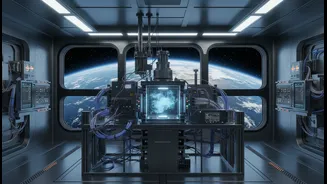
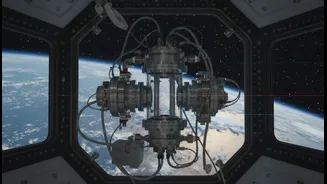
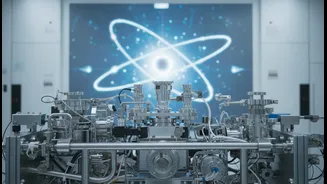
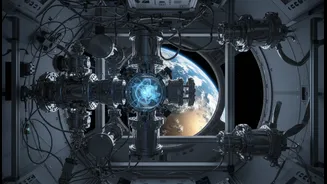
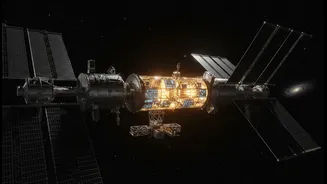
Launched to the International Space Station in 2018, the Cold Atom Lab (CAL) is a remotely operated physics facility designed to study quantum phenomena in microgravity. Its main purpose is to cool atoms down to temperatures just a fraction of a degree
above absolute zero, the theoretical point where all atomic motion ceases. By doing this, scientists can create and study an exotic state of matter that is impossible to maintain on Earth. The entire lab is a marvel of miniaturization, packing equipment that would normally fill a large room into a compact module. This allows for long-term experiments exploring the fundamental nature of atoms, all controlled by scientists back at NASA's Jet Propulsion Laboratory.
Why Does 'Ultra-Cold' Matter So Much?
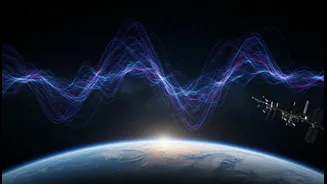
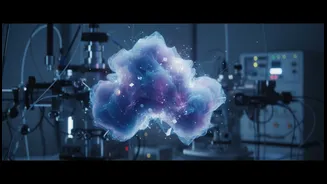
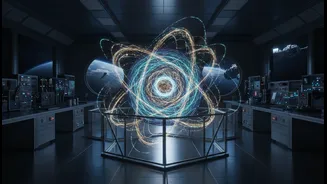
When you chill certain atoms, like rubidium or potassium, to near absolute zero, they stop behaving like individual billiard balls and start acting like a single, cohesive entity—a matter wave. This is the fifth state of matter, known as a Bose-Einstein Condensate (BEC). In a BEC, the weird rules of quantum mechanics become visible on a macroscopic scale, allowing scientists to observe them directly. The problem is that on Earth, gravity pulls these delicate condensates apart in fractions of a second. In the microgravity of the ISS, gravity's influence is negligible. This allows scientists to maintain BECs for much longer—over a second—giving them extended time to watch quantum effects unfold and allowing the condensates to reach even colder temperatures than on Earth.
How Does This Enable Precision Sensing?
The wave-like nature of ultra-cold atoms makes them extraordinarily sensitive to their surroundings. Scientists can harness this property using a technique called atom interferometry. This involves splitting a matter wave, letting the two paths travel separately, and then recombining them. Any force, such as gravity, that acts differently on the two paths will cause a measurable shift in the final interference pattern. Because the atoms in a BEC are all in the same quantum state, they act as a perfect test mass, making these sensors incredibly precise. The longer observation times in space amplify this precision, opening the door for quantum sensors that can make ultra-accurate measurements of gravity, magnetic fields, and other forces.
What Has the Lab Discovered So Far?
Since its installation, CAL has been a hub of discovery. It was the first facility to produce a Bose-Einstein Condensate in Earth orbit. Researchers have used it to create ultracold bubbles, shaping the quantum gas into thin, hollow spheres—a feat impossible on Earth where gravity would cause them to collapse. These bubble-like structures could be used for new types of experiments. Recently, scientists used CAL's atom interferometer for the first time in space to measure subtle vibrations on the space station itself, demonstrating its potential as a highly sensitive environmental sensor. The lab has also received several upgrades, including a new magnetic trap in 2026 that allows for greater control in shaping the quantum gases.
What Are the Future Applications?
The fundamental research at CAL is laying the groundwork for a new generation of quantum technology. Ultra-precise quantum sensors developed from this research could revolutionize navigation, creating GPS-free systems for spacecraft and submarines that can't be jammed. They could also be used to monitor Earth's resources by detecting tiny gravitational shifts caused by moving water, melting ice sheets, or depleting aquifers. These instruments might one day explore other planets by mapping their composition through gravitational variations. On a more fundamental level, the experiments on CAL could provide insights into dark energy and dark matter, and even test the basic principles of physics, like Einstein's equivalence principle, with unprecedented accuracy.