




For decades, we've understood the universe to be about 13.8 billion years old. But what if it’s twice that age? A provocative new study is challenging this fundamental number, sparking a debate that could reshape our entire cosmic story.
Our Cosmic Starting Point
The widely accepted
age of the universe, approximately 13.8 billion years, is a cornerstone of modern science. This figure is derived from the standard model of cosmology, known as the Lambda-CDM model. This model explains everything from the afterglow of the Big Bang, called the cosmic microwave background, to the large-scale structure of galaxies. By measuring the current rate of the universe's expansion and winding the clock backward, scientists have pinpointed this age with remarkable precision. The Lambda-CDM model has been incredibly successful, accounting for the accelerating expansion of the cosmos and the observed amounts of hydrogen and helium. This framework relies on two mysterious components: dark energy, which drives expansion, and dark matter, which provides extra gravitational pull. For years, this has been our best picture of how everything came to be.
A Radical New Timeline
A new model from University of Ottawa physicist Rajendra Gupta proposes a radical rethink: the universe might actually be 26.7 billion years old. This alternative framework, known as CCC+TL, combines two ideas to reach its conclusion. The first is 'Covarying Coupling Constants' (CCC), which suggests that the fundamental forces of nature might not be constant and could have changed over cosmic time. The second is 'Tired Light' (TL), a nearly century-old hypothesis first proposed by Fritz Zwicky. The tired light theory posits that light particles (photons) gradually lose energy as they travel across the vastness of space. By combining these concepts, Gupta’s model reinterprets redshift—the stretching of light from distant galaxies—as a hybrid phenomenon caused by both an expanding universe and light getting 'tired' on its journey. This effectively doubles the cosmic timeline.
The 'Impossible' Galaxy Problem
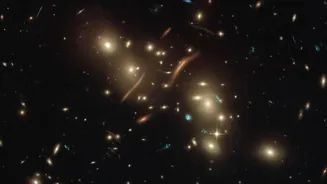
This bold new theory didn't emerge from a vacuum. It was motivated by perplexing discoveries made by the James Webb Space Telescope (JWST). Since it began operations, the JWST has spotted numerous galaxies in the very early universe that are surprisingly massive, structured, and mature. According to the standard 13.8-billion-year model, these galaxies existed just a few hundred million years after the Big Bang, which shouldn't have been enough time for them to grow so large and complex. This has been dubbed the 'impossible early galaxy' problem. Gupta's 26.7-billion-year model offers a straightforward solution: if the universe is older, these early galaxies simply had billions of extra years to form and evolve, making their advanced state entirely plausible. His model also claims to explain cosmic phenomena without the need for dark matter or dark energy.
A Universe of Skepticism
Despite its potential to solve the 'impossible galaxy' puzzle, Gupta’s model faces significant hurdles and is far from being accepted by mainstream cosmology. The standard Lambda-CDM model is supported by an enormous body of evidence from many different types of observations, not just one. The 'tired light' hypothesis, in particular, has been challenged for decades. Critics point out that tired light mechanisms should cause images of distant galaxies to appear blurred, which is not what we observe. Furthermore, observations of distant exploding stars, or supernovae, show time being stretched out in a way that perfectly matches an expanding universe but contradicts tired light theory. For any new theory to replace the standard model, it must be able to explain all the existing evidence just as well, if not better, and so far, alternative models have struggled to do so.