




A New Cosmic Detective
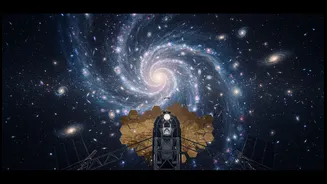
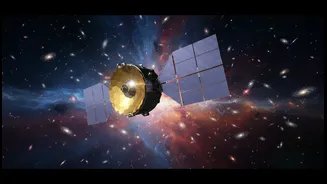
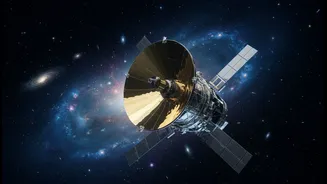
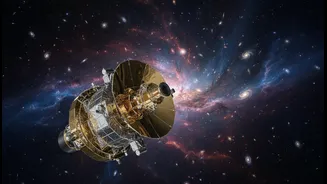
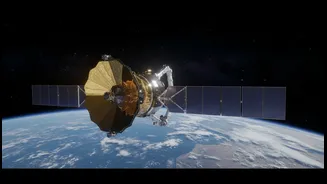
Set for launch on August 30, 2026, aboard a SpaceX Falcon Heavy rocket, the Nancy Grace Roman Space Telescope is NASA's next great observatory. Named after the agency's first chief of astronomy, who championed space telescopes, Roman is engineered for a specific
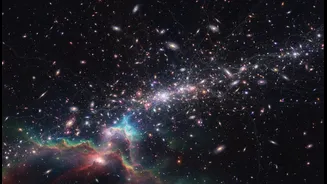
kind of cosmic investigation. While similar in size to the Hubble Space Telescope, its power lies in its incredibly wide field of view. Its Wide Field Instrument will be able to capture a patch of sky at least 100 times larger than Hubble can in a single snapshot, all with the same stunning resolution. This panoramic capability will allow it to map vast regions of the universe faster than ever before, creating the large-scale cosmic charts needed to study the most elusive components of our universe. Having completed its assembly and testing, the telescope arrived at NASA's Kennedy Space Center in Florida in June 2026 for its final launch preparations.
The Universe's Greatest Mystery
So what exactly is Roman hunting for? Its primary target is dark energy, one of the biggest puzzles in modern physics. For decades, scientists expected the universe's expansion, which began with the Big Bang, to gradually slow down due to gravity's pull. However, observations in the late 1990s revealed the opposite: the expansion is accelerating. Dark energy is the name given to the unknown entity responsible for this cosmic push, acting as a sort of anti-gravity. It is believed to make up a staggering 68% of the total mass-energy in the universe. Despite its dominance, we know almost nothing about its true nature. It could be a fundamental property of space itself, known as the cosmological constant, or it could be a new, evolving energy field. Unlocking this secret will not only explain how the universe works but also help predict its ultimate fate.
Three Tools for the Job
To corner its mysterious quarry, Roman will employ a three-pronged strategy, using its giant camera to survey billions of galaxies. The first method involves mapping the positions and distances of millions of galaxies to trace the history of cosmic expansion. This creates a massive 3D map of the universe, revealing how dark energy has influenced the large-scale structure of the cosmos over billions of years. The second approach uses exploding stars called Type Ia supernovae as cosmic mile markers. These supernovas always explode with nearly the same intrinsic brightness, so how faint they appear tells us how far away they are. By comparing their distance to the speed at which they are moving away from us, Roman can measure the expansion rate of the universe at different points in its history. The third technique, called weak gravitational lensing, studies how the light from distant galaxies is subtly distorted by the gravity of matter in the foreground. These distortions reveal the distribution of all matter, including the invisible dark matter, and how that distribution has been affected by the push of dark energy over time.
Beyond the Primary Mission
While dark energy is its main focus, Roman's powerful survey capabilities will revolutionize other areas of astronomy. The same wide-field surveys will also hunt for thousands of planets beyond our solar system, known as exoplanets. The mission is expected to find planets using a technique called microlensing, where the gravity of a star or planet bends the light of a more distant star, causing it to brighten temporarily. This method is sensitive enough to find planets much farther away than other techniques have allowed, helping build a census of worlds across our galaxy. In addition to its primary survey camera, Roman also carries a technology demonstrator called the Coronagraph Instrument. This tool is designed to block the overwhelming glare of a star, allowing astronomers to directly image the much fainter planets orbiting it, a crucial step toward one day analysing the atmospheres of Earth-like worlds.