



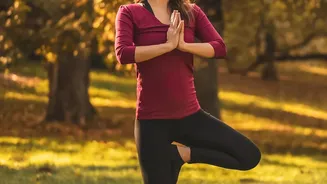
Tree Pose, or Vrksasana, is a cornerstone of many yoga practices, celebrated for building balance and focus. But what if you could transform this familiar pose simply by changing your arms? Let's explore how different arm positions can shift your focus.
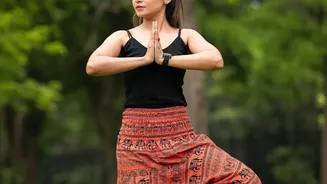
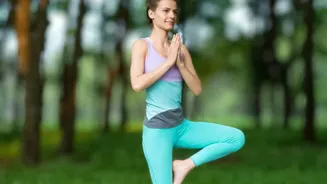
The Foundation: Hands at Heart Centre (Anjali Mudra)
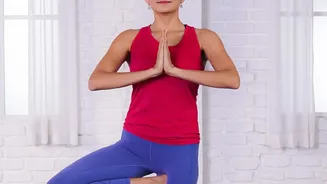
This is the classic expression of Tree Pose. Bringing the palms together at the heart centre in Anjali Mudra is more than just a starting point; it's an act of grounding. This position helps centre your energy and focus your mind, which is essential for maintaining balance. By pressing the palms together, you create a subtle engagement in the chest and shoulders, promoting stability throughout the torso. It allows you to concentrate on the primary actions of the pose: rooting down through your standing leg and keeping your hips level. Before you explore other variations, mastering the balance and stillness with your hands at your heart provides the strong foundation you need to grow.
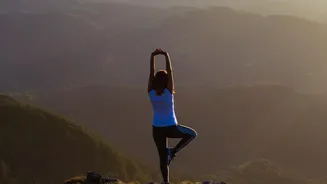
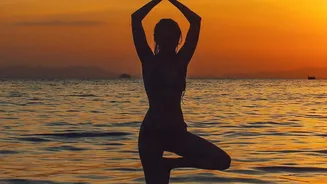
Reaching for Growth: Arms Overhead (Urdhva Hastasana)
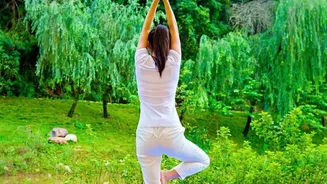
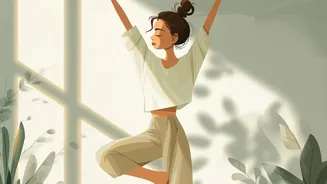
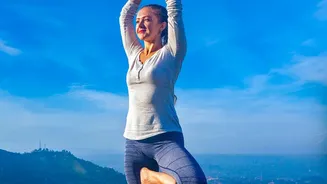
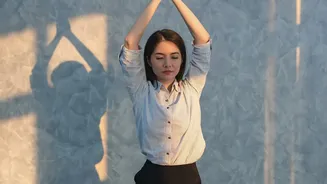
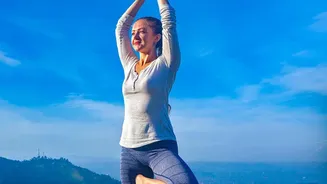
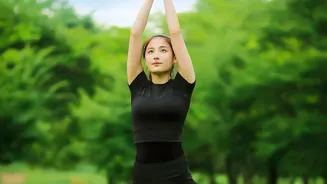
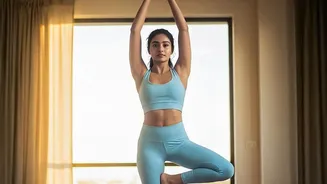
Extending the arms overhead, either with palms touching or shoulder-width apart, mimics the branches of a tree reaching for the sun. This variation instantly elevates the pose from one of simple balance to one of full-body extension. Lifting the arms challenges your stability further by raising your centre of gravity. It creates a beautiful stretch along the sides of your body, through your shoulders, and up to your fingertips, encouraging better posture and spinal lengthening. To maintain integrity in this variation, keep your shoulders relaxed and drawn down your back, away from your ears, ensuring the stretch is expansive, not tense.
Broadening Your Horizon: Arms Out to the Sides
Opening your arms out to a 'T' shape is another way to play with your balance. This variation feels expansive and can help you develop greater spatial awareness. Think of your arms as branches spreading wide, which can sometimes help with stabilization, almost like a tightrope walker using a pole. For an added challenge, you can gently sway your arms like branches in the wind. This dynamic movement forces your core and standing leg to make constant micro-adjustments to keep you upright, turning a static pose into a dynamic stability exercise.
Opening the Heart: Reverse Prayer (Paschima Namaskarasana)
For those looking to deepen the stretch in their shoulders and chest, incorporating Reverse Prayer hands is a powerful option. In this variation, you bring your palms to touch behind your back, with your fingertips pointing upward along your spine. This action provides a significant opening across the front of the shoulders and collarbones, counteracting the slouched posture many of us adopt throughout the day. It's a more advanced variation that requires a good range of motion in the shoulders and wrists. It intensifies the balance challenge, as the arms are no longer free to assist in stabilization.
Deepening the Challenge: Eagle Arms (Garudasana Arms)
Combining the arm position from Eagle Pose with the legs of Tree Pose introduces a complex and rewarding challenge. To do this, you cross one arm over the other, bend the elbows, and bring the palms to touch. This bind creates a deep stretch across the upper back and shoulders. Holding Garudasana arms while balancing on one leg significantly tests your focus and stability. The compact nature of the arms draws your energy inward, demanding intense concentration to prevent wobbling. This variation is excellent for practitioners who feel very stable in the basic Tree Pose and are looking to add a new layer of physical and mental engagement.
A Gentle Side Bend: Bending Tree Pose
Once your arms are extended overhead, you can introduce a gentle side bend. From the tall, extended position, arc your upper body to one side, creating a crescent shape from your standing foot to your fingertips. This variation targets the side body, stretching the obliques and intercostal muscles. It requires significant core strength to maintain both the balance and the integrity of the side bend without collapsing. Always move into the bend slowly and with control, ensuring you are lengthening rather than crunching into your side. It’s a wonderful way to add a new dimension of stretching to a familiar balancing posture.