

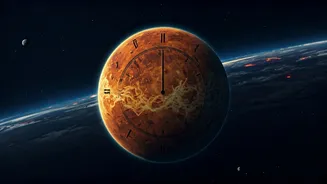


A Tale of Two Clocks
To understand this bizarre fact, we first need to get our definitions straight. For a planet, a 'year' is simply the time it takes to complete one full orbit around the Sun. An 'day' is the time it takes to complete one full rotation on its own axis.
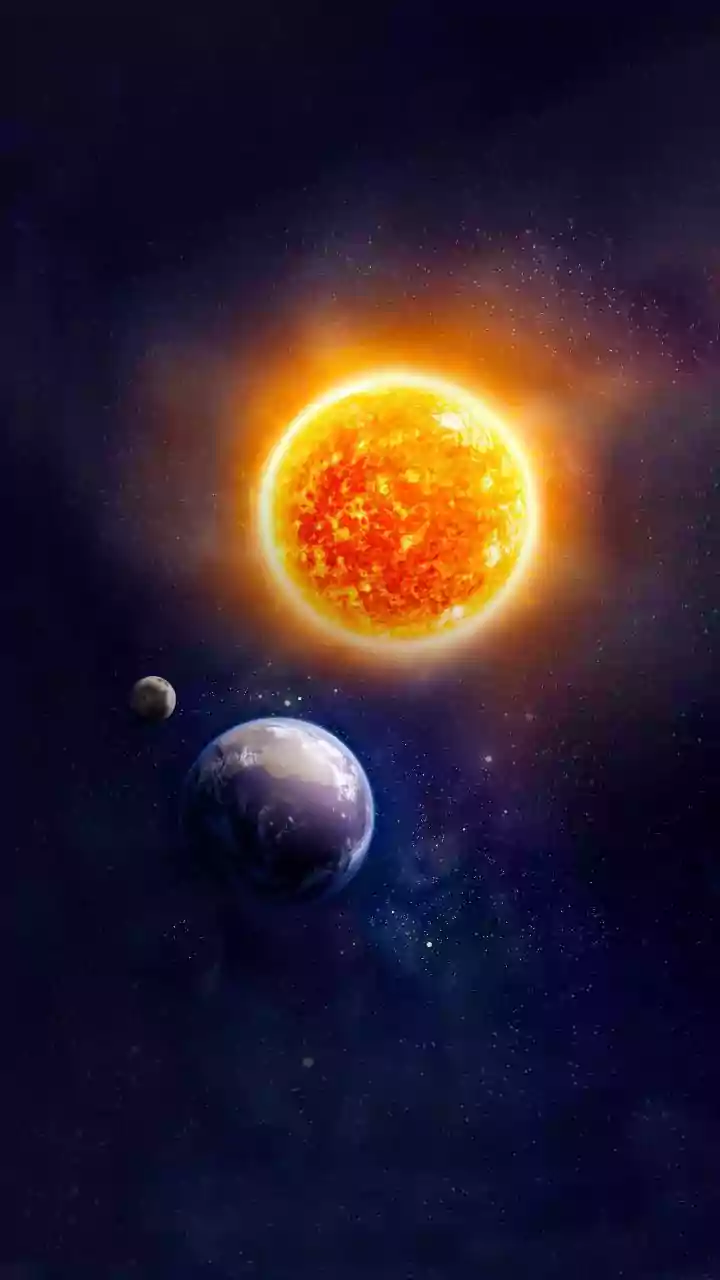
On Earth, this is simple: our planet zips around the Sun in about 365 days, while spinning on its axis once every 24 hours. We experience hundreds of sunrises and sunsets in a single year. Venus, however, plays by a completely different set of rules. It moves through its orbit at a decent pace, but its rotation is astonishingly, almost painfully, slow.
Putting Numbers to the Strangeness
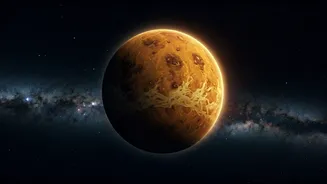
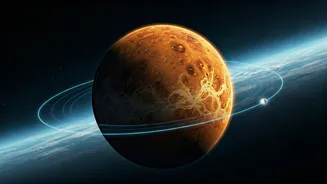
Let’s look at the numbers in terms of our own planet. A year on Venus—one complete trip around the Sun—takes about 225 Earth days. But a single day on Venus—one full rotation on its axis—takes a staggering 243 Earth days. This means that on Venus, a day has passed, but the year hasn't even finished yet. It’s the only planet in our solar system with this strange characteristic. If you could stand on its surface, you would experience a sunrise, an incredibly long period of daylight, and a sunset, but by the time the next sunrise occurred, the planet would have already completed more than one full orbit around the Sun. To make it even more confusing, its 'solar day' (the time from one sunrise to the next) is about 117 Earth days, due to the combination of its slow spin and its orbital motion.
The Backwards Planet
The main culprit behind Venus's marathon day is its rotation. Not only is it slow, but it’s also backwards. Nearly every planet in our solar system, including Earth, spins on its axis in a counter-clockwise direction (prograde motion). Venus spins clockwise, a phenomenon known as retrograde rotation. If you were on Venus, you would see the Sun rise in the west and set in the east. This backward and incredibly leisurely spin is what stretches its day out to be longer than its year. This makes Venus a true outlier, a celestial rebel that refuses to spin in the same direction as its peers.
Why the Bizarre Spin?
Scientists don't have a single, definitive answer for why Venus spins this way, but there are some compelling theories. One leading idea is that Venus may have been struck by a massive asteroid or protoplanet early in its history. Such a cataclysmic impact could have been powerful enough to not just slow its rotation but completely reverse it. Another theory points to Venus's incredibly thick and heavy atmosphere, which is about 90 times denser than Earth's. Over billions of years, powerful atmospheric tides and friction between the dense air and the planet's surface could have acted as a brake, gradually slowing its spin and even flipping it over. A third possibility involves a complex gravitational dance between the Sun's pull and friction between the planet's core and mantle.
A World of Extremes
This slow-motion day has profound consequences for the planet. On Earth, our relatively quick rotation helps distribute the Sun's energy, creating the day-night cycle of heating and cooling that makes life possible. On Venus, the extremely long day means one side of the planet bakes under intense solar radiation for months at a time. However, its super-dense carbon dioxide atmosphere is a brutally efficient insulator. It traps heat and spreads it around the planet, resulting in a runaway greenhouse effect. This is why Venus is the hottest planet in the solar system—hotter even than Mercury, which is closer to the Sun—with a uniform surface temperature of around 465°C, day and night. The long day and thick atmosphere work together to create a stable, hellish environment everywhere on the surface.