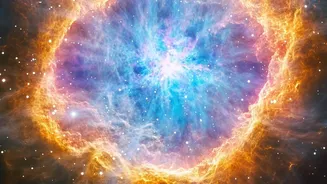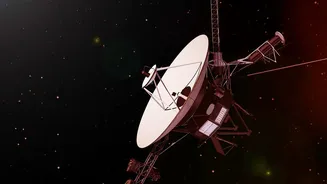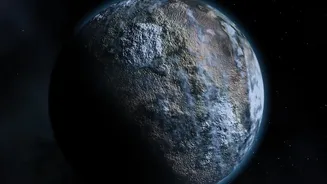



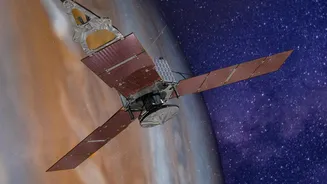
Drifting in the darkness between stars are countless objects too small to be stars, yet too large to be planets. New data from NASA's SPHEREx telescope is pulling back the veil on these dim worlds, revealing surprisingly complex chemical makeups.
A New Eye on the Cosmos
Since
its launch in March 2025, NASA's SPHEREx telescope has been on a unique mission: to map the entire sky in a way no telescope has before. Unlike Hubble or Webb, which zoom in on specific targets, SPHEREx is a surveyor, scanning the whole cosmos every six months. Its full name, Spectro-Photometer for the History of the Universe, Epoch of Reionization, and Ices Explorer, hints at its grand ambitions, from understanding the Big Bang to searching for the ingredients of life. The telescope isn't designed to take breathtaking visual pictures. Instead, it sees the sky in 102 different infrared 'colors', creating a massive 3D map of the universe. This allows scientists to see not just where things are, but also what they're made of.
Decoding Light from Distant Worlds
The key to SPHEREx's power is a technique called spectroscopy. Think of it like using a prism to split sunlight into a rainbow. SPHEREx does something similar with infrared light from stars and other objects. When light passes through an atmosphere, different molecules absorb specific colors, leaving behind a unique chemical 'barcode' in the spectrum. By analyzing this barcode, astronomers can identify the molecules present in that atmosphere, such as water, methane, or carbon dioxide. It's a bit like being a cosmic detective, identifying the chemical fingerprints left behind on a beam of light that has traveled millions of miles through space.
Spotlight on Failed Stars
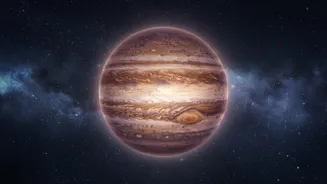
The latest revelations from SPHEREx focus on 'dim cosmic objects' known as brown dwarfs. First discovered in the 1990s, these objects are often called 'failed stars'. They form from collapsing clouds of gas, just like stars, but they never gain enough mass to kickstart the nuclear fusion that makes stars shine. Instead, they smolder with internal heat, glowing faintly in the infrared spectrum. This puts them in a fascinating category somewhere between a giant planet like Jupiter and a small star. Because they drift alone in the dark, they offer a clean look at atmospheric chemistry without the interference of a bright parent star.
A Surprising Chemical Cocktail
In a recent study, researchers used SPHEREx to analyze 37 nearby brown dwarfs, revealing their atmospheres are far more complex and varied than expected. The telescope's spectra clearly showed the presence of water, carbon monoxide, carbon dioxide, and methane. What surprised scientists was the sheer diversity; even two brown dwarfs of the same temperature can have vastly different atmospheric profiles. As these objects cool over billions of years, their clouds and chemistry change. The SPHEREx data shows that current computer models struggle to predict the atmospheric details during these transitions, highlighting that there are still fundamental mysteries about how these worlds work.
From Cosmic Origins to Alien Life
Studying the atmospheres of brown dwarfs isn't just an academic exercise. Many of the same molecules and processes are relevant to understanding the atmospheres of exoplanets, which are much harder to study. These dim worlds serve as a natural laboratory. Beyond that, one of SPHEREx's primary goals is to map the abundance of water ice and other organic molecules—the raw ingredients for life—throughout our galaxy. Recent findings have already shown widespread water ice in starforming regions. By understanding where these lifegiving ingredients exist, from interstellar glaciers to the atmospheres of dim worlds, we get a clearer picture of how common the conditions for life might be across the cosmos.