
A New Eye on the Cosmic Dawn
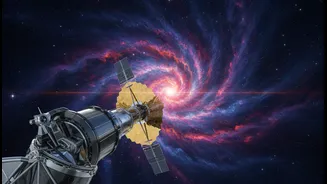
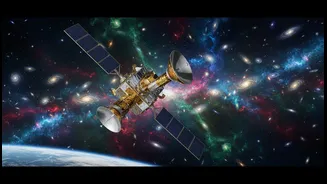
Launched in July 2023, the Euclid space telescope's main job is to create the largest 3D map of the universe to better understand dark matter and dark energy. But its powerful instruments, which capture vast swathes of the sky with incredible sharpness,
are also proving to be perfect for a different kind of cosmic treasure hunt. In recent announcements, scientists revealed that Euclid has identified 31 previously unknown quasars from the universe's infancy. This discovery more than doubles the number of such ancient objects known to science and includes the most distant quasar ever seen, which existed when the universe was only about 670 million years old.
Hunting for Cosmic Lighthouses
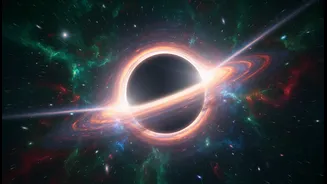
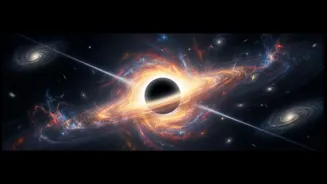
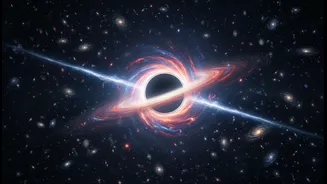
So, what are these 'brightest black holes'? Scientists call them quasars, which is short for 'quasi-stellar radio sources'. A quasar isn't the black hole itself, but rather the intensely luminous region around a supermassive black hole at the center of a young galaxy. As the black hole pulls in enormous amounts of gas and dust, the material swirls into an accretion disk. The immense gravitational and frictional forces heat this disk to millions of degrees, causing it to shine with the light of a trillion suns, often outshining all the stars in its host galaxy combined. This incredible brightness makes them act like cosmic lighthouses, allowing telescopes like Euclid to spot them from over 13 billion light-years away.
A Census of the Early Universe
Finding these objects is about more than just breaking records. Taking a census of quasars is crucial for understanding how the first galaxies and black holes formed and grew. One of the biggest mysteries in cosmology is how supermassive black holes, with masses millions or billions of times that of our sun, could have formed so quickly after the Big Bang. The existing models of black hole growth struggle to explain these cosmic giants in the early universe. By counting how many quasars of different brightness levels existed at that time, scientists can test their theories. Before Euclid, we had only found the very brightest, rarest examples. Now, Euclid is finding a more representative sample, giving us a truer picture of the entire population.
The Power of a Wide, Deep View
Euclid's success comes from its unique ability to survey a huge area of the sky both deeply and sharply, something ground-based telescopes struggle to do efficiently. While each image has a resolution comparable to the Hubble Space Telescope, its field of view is vastly larger, allowing it to scan the sky much faster. This makes it a 'game-changer' for finding rare objects like ancient quasars. In just its first year of observation, Euclid has found more of these distant quasars than had been discovered in the previous decade. This wealth of new data from the Euclid Wide Survey, which will eventually cover about a third of the sky, provides a statistical basis for understanding a critical period in cosmic history known as the 'epoch of reionization', when the first stars and galaxies lit up the universe.
From Counting to Understanding
The information gathered from this quasar census will feed directly into our models of galaxy evolution. Scientists have observed a close relationship between the mass of a galaxy and the supermassive black hole at its center, suggesting they grow together. The newly discovered quasars hint that in the very early universe, the black holes may have been growing faster than their host galaxies. One early analysis showed a black hole that was twice as massive relative to its galaxy as what is typically seen in the local universe today. This kind of data helps astronomers refine their understanding of how these cosmic behemoths influence their surroundings, from regulating star formation to shaping the galaxies we see today.