








A New Frontier for Aerial Exploration
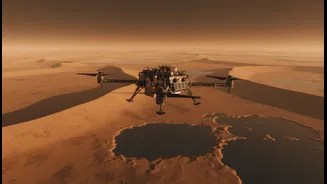
Scheduled for launch in July 2028, NASA’s Dragonfly mission is a revolutionary step in our quest to understand the solar system. Arriving at Titan in 2034, it will become the first powered and fully controlled aircraft to fly on any moon. Unlike the tiny,
solar-powered Ingenuity helicopter on Mars, which proved flight was possible in a thin atmosphere, Dragonfly is a robust science laboratory on wings. Titan's environment makes this possible; its atmosphere is four times denser than Earth's and its gravity is just one-seventh as strong, making flight far more efficient. This allows Dragonfly, an octocopter with eight rotors for redundancy, to be roughly the size of a Mars rover and packed with scientific instruments. Its purpose isn't just to fly, but to perform a multi-year science mission, hopping across Titan's alien landscape.
Engineering for a Frigid, Alien World
Surviving on Titan is an immense engineering challenge. The surface temperature hovers around a staggering minus 180 degrees Celsius. To operate, Dragonfly relies on a Multi-Mission Radioisotope Thermoelectric Generator (MMRTG), the same type of nuclear power source used by the Curiosity and Perseverance rovers on Mars. This device doesn't just provide electricity for flight and scientific operations; it generates crucial heat that is circulated through ducts to keep the craft's sensitive electronics and batteries from freezing. The entire vehicle is encased in a thick layer of insulating foam to retain this precious warmth. Before it even lands, it must survive a fiery entry through Titan's atmosphere, protected by a state-of-the-art heat shield. The mission's design, from its redundant rotor system to its thermal management, is a masterclass in resilience, built to endure years of exploration in one of the solar system's harshest environments.
The Search for Life's Building Blocks
Dragonfly is fundamentally an astrobiology mission. While not expecting to find life itself, its goal is to investigate prebiotic chemistry—the complex chemical steps that occurred on Earth before life emerged. Titan is a prime target because it is a world rich in complex organic molecules. It has a nitrogen-rich atmosphere similar to early Earth, with liquid methane forming rivers and lakes on a surface of water ice. Scientists believe it may have all the ingredients for life: organic materials, energy, and evidence of a liquid water ocean beneath its icy crust. Dragonfly will land at various sites, including impact craters where heat from an asteroid strike may have melted ice and mixed liquid water with surface organics for thousands of years, creating a potential primordial soup. Using instruments like a drill (DrACO) and a mass spectrometer (DraMS), it will sample and analyze the surface to understand how far chemistry has progressed toward life.
A Leap Forward in Planetary Science
The ability to fly transforms planetary exploration. Ground-based rovers are limited, moving slowly and cautiously across difficult terrain. Dragonfly, by contrast, can cover tens of kilometers in a single flight, hopping from one scientifically interesting location to the next in a matter of hours. Its initial landing site is planned for the Shangri-La dune fields, a vast expanse of organic sand-like material. From there, it will embark on a series of flights over its nearly three-year primary mission, exploring a variety of geological settings that would be inaccessible to a rover. This mobility allows for a regional survey rather than a single-point study, providing unparalleled context about Titan as a complex, dynamic world. Armed with cameras and spectrometers, Dragonfly will not only sample materials but also study the geology and meteorology, painting a complete picture of this strange, Earth-like moon.