


A Sweet Discovery in a Gas Cloud
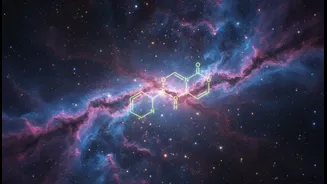
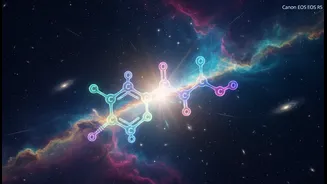
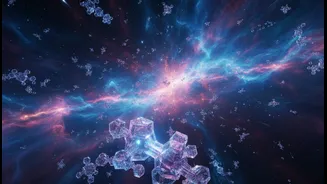
In a remarkable first, an international team of astronomers has directly detected a true sugar molecule, called erythrulose, in the interstellar medium. Using powerful radio telescopes in Spain, they peered into a vast, dense cloud of gas and dust named
G+0.693-0.027, located about 26,745 light-years away near the center of our Milky Way galaxy. There, amidst the cosmic haze, they found the distinct spectral signature of erythrulose, a four-carbon sugar. While on Earth this molecule is naturally found in raspberries and is even used in some sunless tanning products, finding it floating in space is a landmark achievement. It’s the first time any sugar has been definitively identified in the gas between stars, making it a significant step up in the ladder of cosmic chemical complexity.
Why A Sugar in Space Matters
The discovery is far more profound than just a cosmic curiosity. Sugars are fundamental to life as we know it. They are a source of energy for metabolic processes and, most importantly, form the structural backbone of RNA and DNA, the molecules that carry the genetic code. For decades, a central mystery in origin-of-life research has been how these essential molecules first appeared on Earth. Laboratory experiments simulating early Earth conditions have struggled to produce sugars in significant quantities. This has led to a compelling theory: what if the key ingredients for life weren't made on Earth, but delivered from space? Sugars like ribose and glucose have been found in meteorites and asteroid samples before, but this is the first time a sugar has been found in the interstellar raw material from which stars and planets are born.
The Building Blocks of Everything
The detection of erythrulose provides powerful evidence that the chemistry needed for life can begin long before planets even form. These interstellar clouds, often called stellar nurseries, are the very beginning of the story. Scientists believe that erythrulose forms on the icy surfaces of dust grains from simpler molecules. This discovery challenges some previous ideas that complex molecules grow slowly one carbon atom at a time; erythrulose’s relative abundance suggests it may form from the combination of simpler two-carbon molecules. The presence of such a relatively complex molecule suggests that the chemical inventory available for newly forming planetary systems is richer than we might have imagined. This means the building blocks of life could be a common inheritance for planets across the galaxy.
From Space Dust to Life's Origins
So, how does a sugar in a distant gas cloud connect to life on Earth? The theory is that this pre-made organic material gets incorporated into asteroids and comets. Billions of years ago, during a period called the Late Heavy Bombardment, our young planet was pummeled by these celestial objects. This cosmic delivery service could have seeded Earth with a rich supply of prebiotic molecules, including sugars. Scientists estimate that millions of tonnes of erythrulose could have arrived this way. While erythrulose itself isn't a direct part of our DNA, it's a close chemical cousin and can be converted into other crucial molecules in watery environments. For instance, it can be a precursor to ribonucleotides, the building blocks of RNA, which many scientists believe was a predecessor to DNA in the earliest forms of life.
Clarity in the Cosmic News
It's crucial to understand what this discovery doesn't mean. We have not found life in space. We haven't even found a complete, ready-to-go DNA molecule. What we have found is a key ingredient, a piece of the prebiotic puzzle. The headline-grabbing nature of such finds can sometimes lead to oversimplification. The real story is one of patient, incremental science. Each detection of a new molecule, from simple glycolaldehyde years ago to erythrulose now, adds another data point. It refines our models of astrochemistry and strengthens the hypothesis that life's ingredients are not a rare fluke, but a natural consequence of chemistry throughout the universe. The search now continues for even more complex sugars, like ribose, to see just how far this cosmic chemical factory goes.