






The Universe’s Most Extreme Lighthouses
At the end of their lives, massive stars collapse under their own gravity, triggering a supernova explosion. What’s left behind can be a neutron star, an object of almost unimaginable density. A single teaspoon of neutron star material would weigh as much
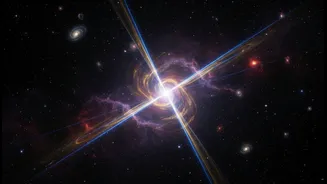
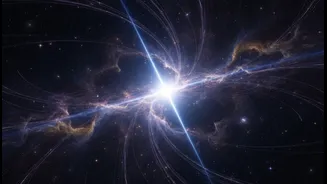
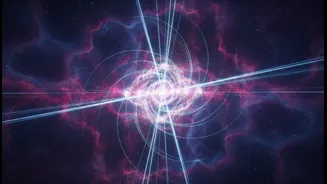
as Mount Everest. Many of these stellar remnants are observed as pulsars. These objects have incredibly powerful magnetic fields that funnel jets of particles and radiation out from their magnetic poles. Because the star’s spin axis and magnetic axis are often not aligned, these beams sweep across the cosmos like a lighthouse. From Earth, when one of these beams flashes across our line of sight, we see a regular “pulse” of radiation. This cosmic lighthouse effect is how pulsars got their name, but it also presents a challenge: we only get a brief glimpse with each rotation, making it difficult to understand the object as a whole.
From a Simple Pulse to a Full Map
For decades, the textbook image of a pulsar was simple: a spinning sphere with two magnetic poles, one on each side, emitting beams of energy. But seeing just a pulse of light is like trying to understand a person’s face by only ever seeing their ear. To truly understand these objects, scientists needed a way to map their surfaces. This is where NASA's Neutron star Interior Composition Explorer (NICER), a telescope aboard the International Space Station, changed everything. By measuring the arrival of X-rays from a pulsar with incredible precision, NICER can detect subtle changes in brightness as the star rotates. An object this dense warps spacetime around it, bending light from the far side of the star toward us. This effect allows NICER to 'see' parts of the pulsar that should be hidden from view, making it possible to map its surface features.
Rewriting the Textbooks
In 2019, teams of scientists used NICER data to create the first-ever surface map of a pulsar named J0030, located 1,100 light-years away. The results were not what they expected. Instead of two neat hot spots at opposite magnetic poles, they discovered a much more complex arrangement. The models revealed two or three hot spots, all located in the pulsar’s southern hemisphere. One spot was small and circular, while another was a long, crescent shape. This discovery shattered the simple dipole model and proved that the magnetic fields of pulsars are far more tangled and complex than previously imagined. Creating this map was a computational feat, requiring supercomputers to process the data and build a model of the star's surface, a task that would have taken a decade on a normal computer.
Visualising the Environment
Mapping the pulsar's surface was just the beginning. More recently, NASA has turned its attention to the environment around these objects. Using the Imaging X-ray Polarimetry Explorer (IXPE) telescope, scientists have begun to map the magnetic fields within the nebulae powered by pulsars. A recent study focused on a pulsar within the 'Lighthouse Nebula.' For years, theories suggested that high-energy particles escaping the pulsar were being guided along the galaxy’s magnetic field lines, creating the nebula's distinct shape. By observing the nebula for nearly 18 days, IXPE was able to measure the polarization of the faint X-rays and confirm with over 99% confidence that the magnetic field does indeed align with the flow of particles, validating a long-held theory.