

The Sun’s Final, Violent Act
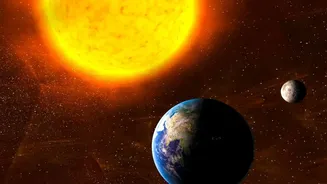
For billions of years, the Sun has been the stable center of our solar system, holding its planets in a predictable cosmic ballet. But its life, like all stars, is finite. In roughly seven to eight billion years, the Sun will run out of the hydrogen fuel
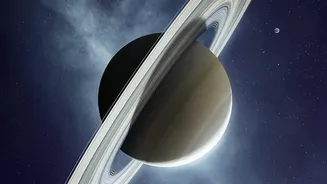
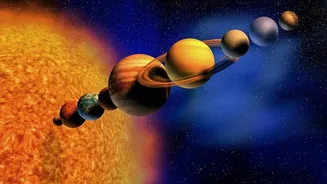
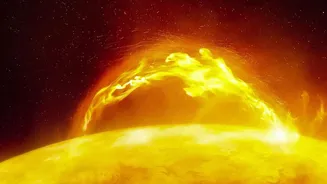
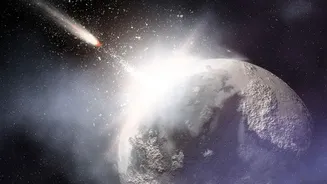
in its core, swell into a red giant, and eventually collapse into a white dwarf — a dense, Earth-sized stellar remnant. For a long time, astronomers believed this process, while catastrophic for inner worlds like Earth, would be a relatively gentle affair for the outer planets. The idea was that as the Sun shed about half its mass, its gravitational grip would weaken, causing Jupiter, Saturn, Uranus, and Neptune to simply drift into wider, stable orbits. However, a groundbreaking new study challenges this peaceful picture. Research from theoretical astrophysicists suggests the Sun's death throes will be far more violent and chaotic, triggering the eventual dismantling of the very system it created.
A New, Chaotically Accurate Model
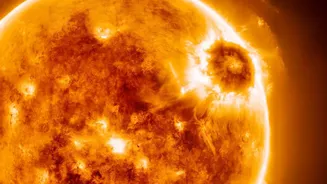
Previous models of the solar system’s end often assumed the Sun would lose its mass smoothly and evenly. This led to predictions that the outer planets could remain in stable orbits for an astonishingly long time — perhaps a hundred billion to even a quintillion years — until a passing star disturbed them. The new research, published in The Astrophysical Journal Letters, introduces a crucial, chaotic variable: the Sun won't shed its mass in a gentle puff, but in clumpy, uneven ejections. As our star becomes unstable, it will throw off its outer layers in random bursts. Each ejection, however small, will give the Sun a tiny gravitational 'kick' in the opposite direction. While a single kick is insignificant, thousands of these random nudges over millions of years will accumulate, subtly altering the Sun's position and its gravitational influence on the giant planets. This introduces an element of chaos that older models overlooked.
The Great Gravitational Scattering
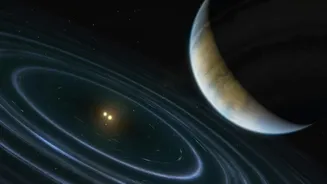
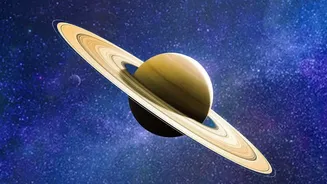
This 'death shake' from the Sun is what triggers the solar system's undoing. The accumulated gravitational kicks will slowly perturb the carefully balanced orbits of Jupiter, Saturn, Uranus, and Neptune. The new simulations, which ran hundreds of different scenarios, found that this instability has dramatic consequences. Over time, the orbits of the giant planets can start to intersect, leading to a period of intense gravitational turmoil. Planets will begin to pull on each other in unpredictable ways, a phenomenon known as scattering. In this cosmic billiard game, some planets might be thrown into highly eccentric orbits, while others could be ejected from the solar system entirely, destined to become 'rogue planets' wandering alone through the Milky Way. This violent reshuffling happens much faster than previously thought, cutting the solar system's expected lifespan by a factor of a billion.
The Future of Our Solar System
According to the models, the chaos could begin even before the Sun fully becomes a white dwarf. In about 40% of the simulations, the planetary system was disrupted while the Sun was still in its red giant phase. Even in the scenarios where the planets survived this initial stage, the vast majority of systems — up to 96% — became unstable within three billion years of the Sun becoming a white dwarf. The fates of individual planets varied wildly across the simulations. In some cases, Uranus and Neptune swapped orbits. In many others, one or more of the giants were flung out into interstellar space. The research strongly indicates that the Sun's death isn't an event the outer planets will quietly survive; rather, it is the direct trigger for their orbital destruction.