







The Ultimate Sky Lifeboat
Sending humans to space is an inherently risky endeavour, especially during launch when the rocket is a controlled explosion propelling a capsule at immense speeds. To counter these risks, every crewed spacecraft is equipped with a launch abort system,
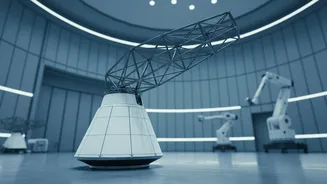
which acts like a sophisticated ejection seat. For Gaganyaan, this is the Crew Escape System (CES), a dedicated mechanism designed for one purpose: to pull the crew module and its occupants away from a failing rocket in milliseconds. This system is not just an add-on; it is a fundamental part of making the launch vehicle 'human-rated', signifying it meets the stringent safety standards required to carry astronauts.
An Escape Plan for Every Second
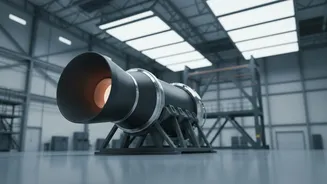
A launch isn't a single event but a sequence of stages, each with unique risks. ISRO has therefore designed abort scenarios for every phase. This includes a 'Pad Abort Test', successfully demonstrated in 2018, which proves the crew can be safely pulled away even before the rocket leaves the launchpad. The ascent phase is even more complex. The rocket experiences enormous aerodynamic stress as it breaks the sound barrier. An Integrated Vehicle Health Management system continuously monitors thousands of data points. If this electronic brain detects a critical anomaly that could endanger the mission, it automatically triggers the CES. The system uses different motors for different altitudes, including the Low-altitude Escape Motor (LEM) and High-altitude Escape Motor (HEM), ensuring a safe escape is possible at any point during the climb through the atmosphere.
Trial by Fire: The High-Altitude Abort Test
Designing a system on paper is one thing; proving it works under the most stressful conditions is another. This is the purpose of the Test Vehicle Abort Mission (TV-D1), conducted in October 2023. In this crucial test, ISRO used a specially designed rocket to simulate a launch. At an altitude of about 17 km and travelling at Mach 1.2 (slightly faster than the speed of sound), the abort was deliberately triggered. This is one of the most aerodynamically challenging moments of a flight. The CES fired its powerful, quick-acting solid motors, generating immense thrust to rapidly separate the crew module from the test vehicle. The entire sequence demonstrated the system's ability to function flawlessly when needed most.
From Violent Pull to Gentle Splashdown
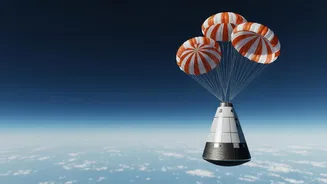
Once the Crew Escape System has pulled the module to a safe distance, its job is done, and it jettisons away. The next challenge is bringing the crew module back to Earth safely. This is handled by a meticulously sequenced parachute system. First, smaller drogue parachutes deploy to stabilize the capsule and slow its descent from high speed. Following this, the main parachutes unfurl, dramatically reducing the speed to ensure a gentle splashdown in the sea. The entire process, from the violent abort initiation to the final, soft landing, is automated to protect the crew. The successful recovery of the crew module during the TV-D1 test proved the entire end-to-end safety sequence works as designed.