




A New Eye on The Ice
The NISAR (NASA-ISRO Synthetic Aperture Radar) mission is a landmark collaboration between the US and Indian space agencies, representing one of the most advanced Earth-observation satellites ever built. Launched in July 2025, it is equipped with two
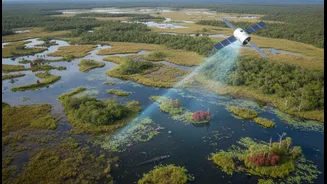
powerful radar systems, L-band and S-band, which work together to scan nearly the entire planet every 12 days. Unlike standard optical satellites that need daylight and clear skies, NISAR's radar can penetrate clouds, darkness, and even snow cover. This makes it uniquely suited to monitor the most remote and dynamic parts of our world, especially the polar regions which are often shrouded in darkness for months.
Seeing the Unseen
The headline-grabbing images, which have now been made public, don't show what's literally 'beneath' the ice in the way an X-ray would. Instead, they reveal something more subtle and, for scientists, more powerful. NISAR sends down polarised microwave signals and reads how they bounce back. Smooth, stable ice reflects the signal cleanly, shown in images as magenta. But where the ice is fractured, cracked, or stressed, the signal scatters differently, appearing as green or white. These patterns reveal deep crevasses and areas of intense stress that are invisible to the naked eye. One recently released image, nicknamed 'the hummingbird' by scientists, shows a mountain peak punching through the ice, with the flow of the glacier around it creating a stunning pattern of fractures that resembles a bird.
What the New Images Show
The 'hummingbird' image is more than just a beautiful picture. It's a powerful demonstration of NISAR's capability. It shows the immense stress a subglacial mountain places on the flowing ice sheet above it, creating a network of deep cracks. By repeatedly imaging areas like this, scientists can track changes in ice velocity, the shifting of grounding lines (where ice begins to float on the ocean), and the overall stability of glaciers with unprecedented precision. This continuous monitoring helps researchers understand the complex mechanics of ice sheets, revealing how they respond to warming ocean waters and changing climate conditions. These are the 'hidden changes' that are critical for predicting the future of Antarctica.
Why Antarctica Matters to India
What happens in Antarctica doesn't stay in Antarctica. The frozen continent holds about 70% of the world's freshwater, and if it were all to melt, global sea levels could rise by nearly 60 metres. While a total meltdown isn't imminent, even a small increase in the rate of melt has major consequences. For India, with its 7,500-kilometre coastline and major coastal cities like Mumbai, Kolkata, and Chennai, the threat is direct and severe. Rising sea levels will increase the risk of flooding, erosion, and storm surges. Understanding the pace of Antarctic melt is therefore not an abstract academic exercise; it is essential for climate modelling and for preparing India's coastal communities for the challenges ahead. NISAR’s data will be a crucial input for these vital predictions.