




What is the Golden Coffee Ratio?
In the world of specialty coffee, the 'golden ratio' is a widely accepted starting point for brewing a balanced cup. While the exact numbers vary slightly, a common range is between 1:15 and 1:18. This simply means for every 1 gram of coffee, you should
use between 15 and 18 grams of water. For instance, the Specialty Coffee Association (SCA) established a 'Golden Cup Standard' that suggests a ratio of 55 grams of coffee per litre of water, which is approximately 1:18. This isn't a strict law, but rather a proven guideline that provides a reliable foundation for brewing. A ratio of 1:15 will produce a stronger, more concentrated brew, while a 1:18 ratio will result in a lighter, more delicate cup. Think of it as a trusted recipe that puts you in the perfect zone for great flavour.
The Problem with 'Eyeballing It'
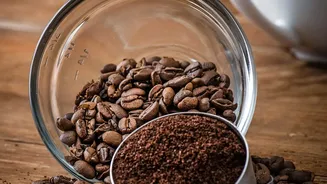
Many home brewers rely on scoops to measure their coffee, but this method is notoriously unreliable. The core issue is that scoops measure volume, not weight, and coffee beans are not uniform. Factors like bean variety, size, and roast level all impact density. Darker roasts, for example, are physically larger and less dense than lighter roasts, meaning a scoop of dark roast beans contains less actual coffee by weight. Grind size also creates huge variations; a scoop of finely ground coffee will hold significantly more coffee than a scoop of coarse grounds. This means that even if you use the same scoop every day, you could be using a different amount of coffee without realizing it, leading directly to that frustrating inconsistency in flavour and strength. A scale removes this guesswork entirely.
The Simple Science of Extraction
Brewing coffee is essentially a process of extraction: hot water dissolves the flavourful compounds from the coffee grounds. These compounds—which include acids, sugars, and oils—dissolve at different rates. If your brew is too quick or you don't use enough water, you get under-extraction, resulting in a sour, thin-tasting cup. This is because the bright, acidic compounds dissolve first. If you brew for too long or use too little coffee, you risk over-extraction, which pulls out the bitter compounds that dissolve later, leading to a harsh, dry taste. The golden ratio helps you find the 'sweet spot'. By controlling the amount of coffee and water, you give the water just enough time and capacity to dissolve the desirable flavours without pulling out the unpleasant ones, creating a balanced and delicious cup.
How to Use the Ratio at Home
Putting the golden ratio into practice is easy and requires only one crucial tool: a simple kitchen scale. For an average-sized mug of about 300 ml, a 1:16 ratio is a great place to start. Here’s how: place your mug on the scale, tare it to zero, and fill it with water to see how much it holds. Let's say it's 300 grams (since 1 ml of water equals 1 gram). Now, divide your water weight by your desired ratio. So, 300 divided by 16 equals 18.75. You’ll want to use approximately 19 grams of whole bean coffee. Measure out your beans, grind them, and you’re ready to brew. This simple act of weighing your coffee and water is the single most effective step you can take to make your brewing process repeatable and consistently excellent.
Your Starting Point, Not the Final Word
While the golden ratio is an invaluable tool, it's important to remember that it is a starting point, not an unbreakable rule. Think of it as a baseline from which you can explore and find your personal preference. Different brewing methods often have their own ideal ratios. For example, a full-immersion method like a French press often benefits from a slightly stronger ratio, like 1:15, to create a rich, full-bodied cup. A pour-over might taste better at 1:16 or 1:17 to highlight delicate, nuanced flavours. If you like to add milk and sugar, a stronger brew (like 1:15) will hold up better. Don't be afraid to experiment. By starting with the golden ratio, you can make small, deliberate adjustments—one gram at a time—to dial in the perfect cup for your taste.