

The Ultimate Safety Net
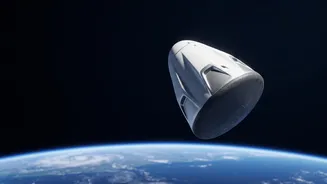
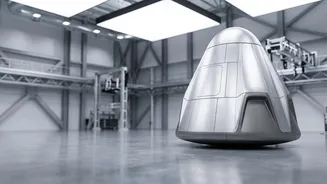
Before Indian astronauts, or 'Vyomanauts', can journey to low-Earth orbit, ISRO must guarantee their safety above all else. This is the primary role of the Crew Escape System (CES). It is essentially a sophisticated ejection seat, not for a single pilot,
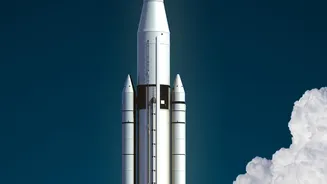
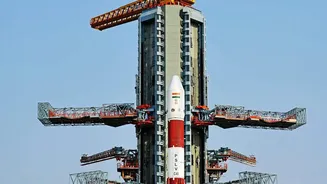
but for the entire crew capsule. The system is designed to detect a catastrophic failure on the launchpad or during the ascent and, within milliseconds, pull the crew module away from the malfunctioning rocket. This 'tractor' style system, mounted on top of the crew module, is a proven concept used by historic programs like Apollo and Soyuz. Its sole purpose is to rescue the crew during the most dangerous phases of a launch, ensuring they can return to Earth safely.
Powering the Escape: The Abort Motors
The incredible force needed to outrun an exploding rocket comes from a cluster of powerful, quick-acting solid rocket motors. These aren't like typical rocket engines; they are designed with high burn-rate propellants that generate immense thrust almost instantaneously. The system includes several types of motors, such as the Low Altitude Escape Motor (LEM) and High Altitude Escape Motor (HEM). During an abort, these motors fire together to produce an acceleration of up to 10 Gs, propelling the crew module up and away from the launch vehicle. The Low Altitude Escape Motor alone generates a massive 842 kN of thrust. This raw power is designed to create a safe separation distance in the shortest possible time, a critical factor when every second counts.
Steering to Safety: Orientation and Control
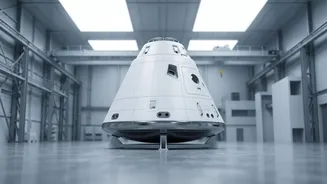
Simply pulling away isn't enough; the escape must be controlled. This is where orientation control thrusters and pitch motors come into play. While the main abort motors provide the brute force, smaller engines like the Pitch Motor are responsible for steering the crew module on a safe trajectory, ensuring it moves laterally away from the rocket's path. The nozzles on the main abort motors are canted to help direct the thrust without complex moving parts. Once the crew module separates from the escape tower, its own set of thrusters take over. The Gaganyaan crew module is equipped with a Reaction Control System (RCS) that includes 12 small thrusters. These are not for propulsion but for precise orientation control—pitch, yaw, and roll—stabilising the capsule as it descends before the parachutes are deployed. This active control is crucial for managing the capsule's attitude as it re-enters the atmosphere.
A Symphony of Systems in Milliseconds
An abort sequence is a perfectly choreographed, high-speed event. An autonomous system continuously monitors the launch vehicle's health. If it detects a critical anomaly, the process is initiated. First, pyrotechnic devices sever the connections holding the crew module to the rocket stack. Simultaneously, the abort motors ignite, pulling the module clear. After burnout, the escape tower is jettisoned from the crew module. The module then re-orients itself using its control thrusters for a stable descent. Finally, a sequence of parachutes—starting with smaller drogue chutes and followed by the main parachutes—deploy to slow the capsule for a soft splashdown in the sea. The entire sequence, from abort trigger to crew module separation, happens in seconds.
Proven Through Rigorous Testing
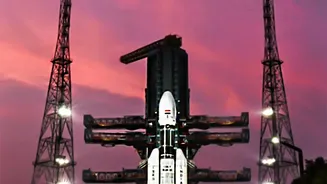
Confidence in such a critical system can only be built through exhaustive testing. ISRO has conducted several crucial demonstrations to validate the Crew Escape System. A Pad Abort Test in 2018 successfully demonstrated the system's ability to pull the capsule away from a launchpad emergency. More recently, the Test Vehicle Abort Mission-1 (TV-D1) in October 2023 proved the system's effectiveness during an in-flight abort scenario at transonic speed (Mach 1.2), one of the most aerodynamically stressful points of ascent. In this test, a dedicated test vehicle simulated a launch, an abort was intentionally triggered at an altitude of about 17 km, and the crew module successfully separated, descended under parachutes, and was recovered from the Bay of Bengal. These successful tests are major milestones, proving the maturity of the technology and ISRO's commitment to astronaut safety.